

How to Control Legionella in Cold-Water Storage Tanks
In this article, we’ll go into detail about how to control Legionella in cold water storage tanks. We’ll explain what these tanks are, what they are used for and where they are commonly found. We’ll cover some basics around Legionella bacteria, what it is, why it’s a health hazard and where it’s found. We’ll then go into detail about tank inspections, how often they should be done, things to look out for, and specifically how to control Legionella risks.
What is a cold-water storage tank?
A cold-water storage tank is a container used to store cold water for domestic, commercial, or industrial purposes. Typically made from plastic, glass reinforced plastic, steel and stainless steel, or concrete, such tanks provide a reserve of water to ensure continuity of supply and help maintain pressure.
Commonly found on rooftops, in loft spaces, and in plant rooms they serve domestic water supplies, booster systems, fire protection systems, and cooling towers. Proper maintenance, including regular cleaning and disinfection, secure lids, insulation, and overflow management, is essential to prevent bacterial and other contamination, and to ensure water efficiency.
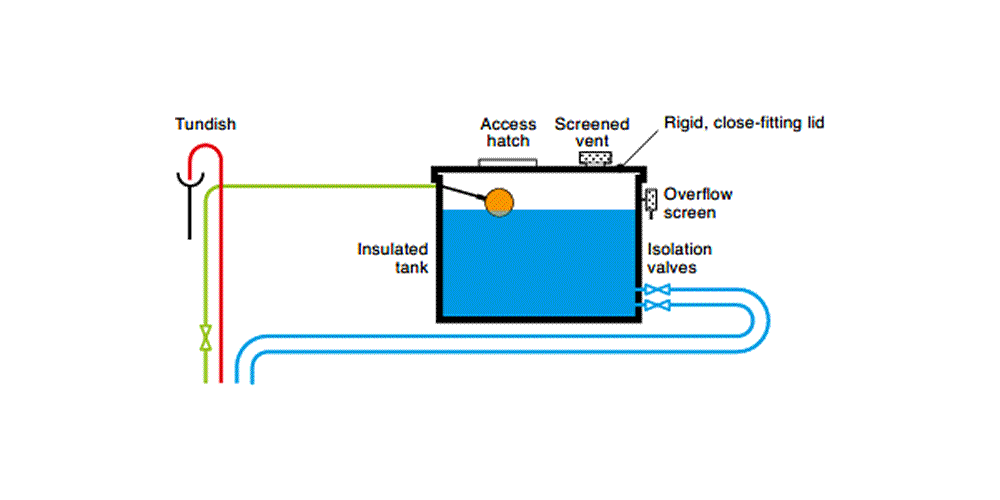
Good water storage tank design from HSG 274.
What is Legionella?
Legionella is a bacterium that is found in many natural water sources such as rivers and lakes. It is also found in man-made water systems, and this is where it has the potential to become problematic to human health if the bacterium are allowed to grow beyond safe levels.
How can Legionella bacteria make you ill?
Legionella bacteria can be present in water droplets such as mist or water vapour. If this is inhaled, the bacteria can travel to the lungs and cause a potentially fatal form of pneumonia known as Legionnaires’ disease. There is also a less serious form of the disease, called Pontiac fever.
Legionnaires’ can develop with similar symptoms to colds and flu, so it can be hard to diagnose. However, if you suspect you have Legionnaires’ disease, you should seek medical advice and treatment as soon as possible.
Is Legionella present in mains water?
The Drinking Water Inspectorate in the UK is responsible for testing drinking water to confirm its safety – and the UK has exceptionally high standards for drinking or potable water. This means the mains water reaching your building is as safe as it can possibly be.
However, there is still a slim chance there could be small traces of Legionella bacteria in the water. Miniscule levels of Legionella would pose no harm at all, but it is vital that the water system – and cold-water tanks – used in a building receiving mains water does not allow those levels of bacteria to rise.
Can Legionella survive in cold-water storage tanks?
Yes, if the conditions allow this to happen, Legionella bacteria can multiply and spread inside a cold-water tank. Cold-water tanks must have an overflow pipe, a cover to prevent debris, insects or vermin from getting inside, and sufficient insulation to protect against freezing. The insulation should also ensure that the cold water does not become excessively warm in good weather. This insulation is designed to ensure the water temperature remains within allowed parameters below 20oC.
How often should a cold-water tank be inspected?
The Health and Safety Executive, in their guidance document HSG274 recommend cold-water tanks should be inspected at least annually, unless indicated by the Legionella risk assessment, if there is a change in use or any other change in the hot and cold-water system within the building the tank serves. For example, if building work is undertaken that will affect the use of the tank, it should be inspected once the work is complete.
The annual inspection should suffice unless evidence is spotted during the inspection that would point to the need for it to be done more often. The tank is not likely to remain spotless, but if heavy amounts of silt or other debris are found, corrosion of pipes or tank supports is spotted, or any damage is noted to the overflow pipe, insulation, or other components, this should be immediately taken care of. It may mean there is insufficient cleaning or maintenance happening and may point to a need for more frequent inspections.

Guidance from HSG 274 on cold water tank inspections.
Can Legionella bacteria survive in a cold-water tank?
For Legionella to grow and spread in a cold-water tank, the conditions must allow this to happen. Legionella bacteria will multiply in temperatures of between 20-45 degrees Celsius. If the water temperature is below 20 degrees, as it should be in a cold-water tank, they will become dormant and therefore cannot multiply.
However, it’s not just the water temperature that is of concern. The bacteria must have sufficient nutrients to grow and multiply. In the case of a cold-water tank, these nutrients can be sourced from scale formation, excessive corrosion of parts, organic debris and insufficient cleaning to remove them.
Hence the need for regular inspections, cleaning and disinfection, as these will combine to ensure the tank is safe and does not pose an attractive place for the bacteria to multiply. This could also potentially lead to them spreading throughout the entire water system.
Can tank size encourage Legionella growth?
Yes, incorrectly sized water tanks can encourage the growth of Legionella. The cold-water tank should always be of a sufficient size to cater for the requirements of the business or building it is used for. If the tank is too large, the water inside it will not be used at a sufficient rate. This means there is a far bigger risk of stagnant water becoming an issue. Legionella and other bacteria cannot easily establish themselves in flowing water. Stagnant water sitting inside a water tank for any reason will therefore become an attractive place for Legionella bacteria to proliferate.
It’s worth mentioning that an oversized tank is not the only potential issue here. A cold-water tank could be the correct size for the building, but if it is not used as often as expected, occupancy rates reduce or the building has changed in use, it may represent a risk where there wasn’t one before. Again, this would invite stagnant water, bacterial growth and potentially more risks associated with scale formation.
How to control Legionella risks in cold-water storage tanks?
The annual inspection is just one part of the required approach to maintaining safe cold-water tanks that do not invite excessive Legionella bacteria. Regular cleaning, disinfection and maintenance, along with ensuring the tank is fit for purpose in terms of size and demand placed upon it, also play key roles. Regular water treatments also come into play.
Anyone who is responsible for maintaining and checking the condition of cold-water tanks such as the Responsible Person, risk assessor or maintenance contractor should have proper Legionella training. This should ensure they have the required knowledge and competence to know where the risks are and what they should look for when examining the tank.
While the mains water supply is perfectly safe and ready to drink when supplied to a building, it is the responsibility of the building owner or occupier to ensure it stays that way. The cold-water tank may not seem like the most obvious place for Legionella bacteria to multiply, but as we’ve seen, given the right conditions, it can indeed do so.
Expert Water Treatment and Water Safety Solutions
Water Treatment Services provide a comprehensive range of water and wastewater treatment, water quality analysis, consultancy, and water engineering solutions to support business owners and those responsible for the safe and efficient operation of water systems in the workplace.
Contact us today to learn how our water treatment specialists can help you manage your water systems, maintain regulatory compliance, and ensure safe, reliable performance.
With offices in London serving the South and South East England, Manchester (North West), Birmingham (Midlands), Bristol (South West England and Wales), Leeds (North and North East), and Glasgow (Scotland), supported by regional teams of highly trained technicians and engineers, we deliver specialist consultancy, water quality analysis, engineering support, and risk management solutions across the UK and internationally.
Contact us today to find out how our water treatment and water engineering solutions can support your organisation.