• Link to X
  • Link to Facebook
  • Link to LinkedIn
  • Link to Mail
  • Call Me Back
  • About
  • Knowledge
📞 Call us on 0330 223 31 31
Water Treatment Services
  • Home
  • Water
    • Applications
      • Boiler Water Treatment Services
      • Cooling Water Treatment
      • Closed Loop Water Treatment
    • Services
      • Cooling Tower Cleaning Services UK
      • Cooling Tower Maintenance
      • Chlorine Dioxide Water Treatment Services
      • Commercial Water Softeners
      • Expert Witness Services
      • Pre-Commission Cleaning
      • Tank Reline & Repair
      • TMV Servicing
      • Water Chlorination & Disinfection
      • Water Leak Detection
      • Water Testing
        • Drinking Water Testing Services UK
        • Testing Water for Heavy Metals
        • Pool Water Testing
        • BSRIA Closed System Testing
        • SDI Testing & Analysis
        • Trade Effluent Testing
    • Training
      • Water Treatment Training
      • Basic Chemistry of Water
      • Industrial Treatment
      • Pre-Treatment
      • Boiler Treatment
      • Cooling Systems
      • Closed Systems
      • Wastewater Training
      • Advanced Treatments
      • Training Dates 2025
  • Wastewater
    • Testing Water for Heavy Metals
    • Trade Effluent Testing
    • Wastewater Training
    • Expert Witness Services
  • Chemicals
    • Water Treatment Chemicals
      • Boiler Water Treatment Chemicals
  • Air
    • Ductwork Cleaning
    • Indoor Air Quality
    • Local Exhaust Ventilation Testing
    • Mould Testing
    • Expert Witness Services
  • Energy
  • Contact
  • Click to open the search input field Click to open the search input field Search
  • Menu Menu
You are here: Home1 / Knowledge2 / Energy3 / What is Turbidity in Water?
What is Turbidity in Water?

What is Turbidity in Water?

In this article the industrial water quality specialists at Water Treatment Services explain the term “turbidity” and highlight why it is an important metric used to assess water quality.

The article explains what turbidity is, what causes it, why it’s important and how it is measured. It then looks at UK water quality guidelines, popular water treatment protocols for controlling turbidity, and the link between turbidity and suspended solids.

What is turbidity in water?

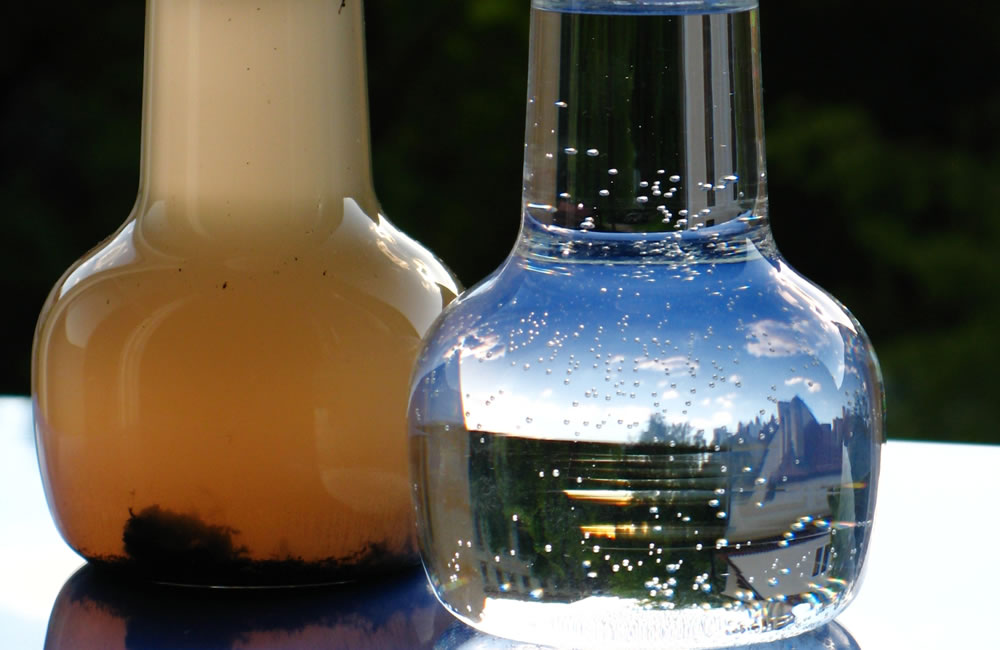
Turbidity isn’t one of those words which you’re likely to hear in everyday conversation. It’s one of those words which is common in the water treatment industry, where engineers will use it regularly and forget that it’s an unknown term for most of us. Although the term “turbidity” might seem very complex, all it really means is the level of cloudiness in water.

Cloudiness in water is usually caused by particles which get into the water system. These particles are then suspended in the water, and although they are too small to see individually, when present in large numbers they can make the water appear cloudy. These particles are usually oil, proteins, bacteria, dirt or algae.

How to measure turbidity in water?

Turbidity means more than just how cloudy or otherwise water is. Turbidity is also the way in which this cloudiness is measured, typically using an optical device which shows up these hidden particles in the water. A beam of light is used to shine through the sample, and then a measurement can be taken to calculate the number of particles in the water by the reduction in intensity of the beam. The higher the number of particles or the greater the concentration, then the higher the level of turbidity.

The two main types of turbidity detectors are:

  • Turbidimeters

    Turbidimeters detect light transmitted through a solution at 180°.

  • Nephelometers

    Nephelometers detect the strength of scattered light using a sensor at 90°.

What causes turbidity in water?

There’s nothing worse than turning on the tap for a refreshing glass of cold drinking water, and seeing cloudy liquid in the glass. It’s not the thirst-quenching drink you were hoping for, so most of us tip it into the sink and then let the tap run a bit longer before pouring another glass.

  • Learn more about water quality analysis

Contamination causing cloudiness in drinking water can be caused in a number of ways. Sometimes it is down to environmental contamination, and in other situations it is caused by human actions or behaviour. Chemicals such as phosphorus which are used in wastewater treatment or as agricultural fertilisers can get into the water supply, and lead to the unwanted growth of algae, which in turn leads to increased turbidity. In areas of the country with lots of bog or marsh areas, then the tannic acid from the soil can also cause discolouration or turbidity in the water too.

After periods of heavy rainfall, mud and silt can run off construction or agricultural sites into the water source. This causes an entirely natural process, but can also explain why turbidity in water does seem to fluctuate according to the time of year or the prevailing weather conditions.

Turbidity in water can cause damage to your taps or valves, and might also block up filters or pipework as well as causing contamination in any water storage tanks. The Environment Agency and other official bodies spend a lot of time and effort in monitoring agriculture and industrial practices to help them detect possible sources of contamination and pollution quickly.

What are the UK’s turbidity standards for drinking water?

The UK water industry aims to take steps to actively minimise turbidity in water, and ideally, get rid of it completely. This involves a range of treatment and water analysis processes which measure the quality of water at various stages of the distribution system to make sure everything is working properly. This also ensures that water companies are complying with all laws and regulations which are relevant.

The industry standard way of measuring turbidity is in nephelometric turbidity units or NTU.

UK guidelines state that drinking water at the tap should have a turbidity level below 4 NTU or less and this will appear clear. If the levels climb above 5 units, then this will usually be detected by users of the water supply. At 55 NTU the water will begin to look cloudy. Over 500 NTU and the water will appear completely opaque. If the water supply has had chlorine added, then again the turbidity levels should be less than 5, and preferably less than 1 NTU as this gives a good indication that the chlorination is working properly.

  • Drinking water testing

The link between chlorination and turbidity

In theory, adding chlorine as a disinfectant to water is a sure-fire way of reducing levels of turbidity in the water. In practice, it’s a bit trickier than that. If the water has very high levels of turbidity, this might interfere with the way in which the chlorine works. Even low levels of turbidity might stop the chlorine from working properly and prevent the chlorine from killing off the bacteria which might be in the cloudy water.

What are the best protocols to avoid and deal with turbidity in water?

Pre-filter gravel beds, coagulators or other products can all help address the potential risks of having high levels of turbidity in water. It is also a good idea to have a system for measuring and testing the water at various stages in the treatment process as this will help you identify “bottlenecks” in the system where you might want to prioritise cleaning or maintenance. Turbidity measurement is usually done using an electronic meter (Turbidimeter or Nephelometer), or by using a special turbidity tube, both of which will give you a result in NTU units mentioned earlier. Both of these ways of measuring turbidity have their own advantages and disadvantages.

Turbidity meters

Turbidity meters are often the preferred method when testing at very low levels, under 5 turbidity units. This is because the meters are very accurate at this level of turbidity. The disadvantage is that the meters can be very expensive, and have to be connected to either a mains power supply or a battery pack for operation.

Turbidity tubes

Turbidity tubes are much more cost-effective, and are robust pieces of measuring equipment. However, they are less precise than using a meter, and are not nearly as useful for measuring low levels of water turbidity.

Turbidity and suspended solids

There is definitely some common ground between measuring turbidity and also measuring total suspended solids, or TSS. However, TSS is usually measured by looking at the various solids suspended and the weights or mass of each, whereas turbidity is more about looking at the overall mass and the effect on water quality as a consequence.

Expert industrial wastewater treatment solutions

Water Treatment Services offer a comprehensive range of innovative water and wastewater management solutions for business. Our experts can provide advice and support to help you identify the most appropriate strategies for the identification, investigation and implementation of environmentally sensitive testing, monitoring and treatment solutions for industrial wastewaters and trade effluents.

With offices in London serving the South and South East England, Manchester (North West), Birmingham (Midlands), Bristol (South East England and Wales), Leeds (North and North East) and Glasgow (Scotland), supported by regional teams of specially trained engineers and wastewater treatment specialists we offer cost effective environmental support solutions across the whole of the UK and internationally.

Contact us today to learn how our wastewater solutions can help you reduce costs and improve environmental performance.
Contact Us Today

Tags: Turbidity, wastewater, Wastewater treatment, Water testing
You might also like
What are the advantages of improving wastewater treatment processes? What Are the Advantages of Improving Wastewater Treatment Processes?
Testing aerobic colony counts in water Testing Total Aerobic Colony Counts in Water
How are business water bills and sewerage charges calculated? How are Business Water Bills & Sewerage Charges Calculated?
How to safely dispose of used cooking oil How to Safely Dispose of Used Cooking Oil
Swimming pool related illnesses Swimming Related Pool Illnesses: Is it Safe to Go into the Water?
What is water microbiology? What is Water Microbiology & How Can it be Used to Improve Water Quality?
Blue-green algae testing Blue-Green Algae Testing in Lakes, Ponds & Recreational Waters
Creating a safe swimming pool environment Creating a Safe Swimming Pool Environment

Search…

Search Search

What's New

  • Swimming Pool Water Testing UK: Complete Compliance Guide for Pool Operators & Facilities Managers

    Swimming Pool Water Testing UK: Complete Compliance Guide for Pool Operators & Facilities Managers

    Swimming pool water quality is one of those things …
  • Cooling Tower Compliance Check – Free Online Assessment

    Cooling Tower Compliance Check – Free Online Assessment

    How confident are you that your cooling tower management …
  • What are the 4 Main Methods for Treating Industrial Wastewater?

    What are the 4 Main Methods for Treating Industrial Wastewater?

    We all rely on water every day yet rarely …
  • Water Quality Assessment: 3 Key Areas for Safe Water Systems

    Water Quality Assessment: 3 Key Areas for Safe Water Systems

    Assessing water quality is a fundamental part of managing …
  • Water Quality Analysis for Modern Industries

    Water Quality Analysis for Modern Industries

    Understanding the quality of water used across modern industries …
  • Free Boiler Health Check & Boiler Water Treatment Assessment

    Free Boiler Health Check & Boiler Water Treatment Assessment

    Even small boiler water quality issues can lead to …

REVIEWS

4.8
Water Treatment Services is rated 4.8 out of 5 stars (based on 103 reviews)
Read our reviews

Newsletter

Receive exciting features, news, latest research and special offers! Just add your email address and we'll do the rest.

Contact us

Water Treatment Services

[email protected]

Tel: 0330 223 31 31

© Copyright 2026 - EDG Ltd. Operating as Water Treatment Services
  • Link to X
  • Link to Facebook
  • Link to LinkedIn
  • Link to Mail
  • Home
  • About
  • Careers
  • Privacy
  • Environment
  • Reviews
  • Login[learndash_login login_label=”Login/Register” logout_label=”Logout”]
  • Sitemap
Link to: How Does Wastewater Impact Our Environment? Link to: How Does Wastewater Impact Our Environment? How Does Wastewater Impact Our Environment?How does wastewater impact our environment? Link to: BS 8680:2020 and Water Safety Planning Link to: BS 8680:2020 and Water Safety Planning BS 8680:2020 and water safety planningBS 8680:2020 and Water Safety Planning
Scroll to top Scroll to top Scroll to top

This site uses cookies. By continuing to browse the site, you are agreeing to our use of cookies.

OK

Cookie and Privacy Settings


How we use cookies

We may request cookies to be set on your device. We use cookies to let us know when you visit our websites, how you interact with us, to enrich your user experience, and to customize your relationship with our website.

Click on the different category headings to find out more. You can also change some of your preferences. Note that blocking some types of cookies may impact your experience on our websites and the services we are able to offer.

Essential Website Cookies

These cookies are strictly necessary to provide you with services available through our website and to use some of its features.

Because these cookies are strictly necessary to deliver the website, refusing them will have impact how our site functions. You always can block or delete cookies by changing your browser settings and force blocking all cookies on this website. But this will always prompt you to accept/refuse cookies when revisiting our site.

We fully respect if you want to refuse cookies but to avoid asking you again and again kindly allow us to store a cookie for that. You are free to opt out any time or opt in for other cookies to get a better experience. If you refuse cookies we will remove all set cookies in our domain.

We provide you with a list of stored cookies on your computer in our domain so you can check what we stored. Due to security reasons we are not able to show or modify cookies from other domains. You can check these in your browser security settings.

Google Analytics Cookies

These cookies collect information that is used either in aggregate form to help us understand how our website is being used or how effective our marketing campaigns are, or to help us customize our website and application for you in order to enhance your experience.

If you do not want that we track your visit to our site you can disable tracking in your browser here:

Other external services

We also use different external services like Google Webfonts, Google Maps, and external Video providers. Since these providers may collect personal data like your IP address we allow you to block them here. Please be aware that this might heavily reduce the functionality and appearance of our site. Changes will take effect once you reload the page.

Google Webfont Settings:

Google Map Settings:

Google reCaptcha Settings:

Vimeo and Youtube video embeds:

Other cookies

The following cookies are also needed - You can choose if you want to allow them:

Privacy Policy

You can read about our cookies and privacy settings in detail on our Privacy Policy Page.

Privacy
Accept settingsHide notification only