What is Turbidity in Water?
In this article the industrial water quality specialists at Water Treatment Services explain the term “turbidity” and highlight why it is an important metric used to assess water quality.
The article explains what turbidity is, what causes it, why it’s important and how it is measured. It then looks at UK water quality guidelines, popular water treatment protocols for controlling turbidity, and the link between turbidity and suspended solids.
What is turbidity in water?
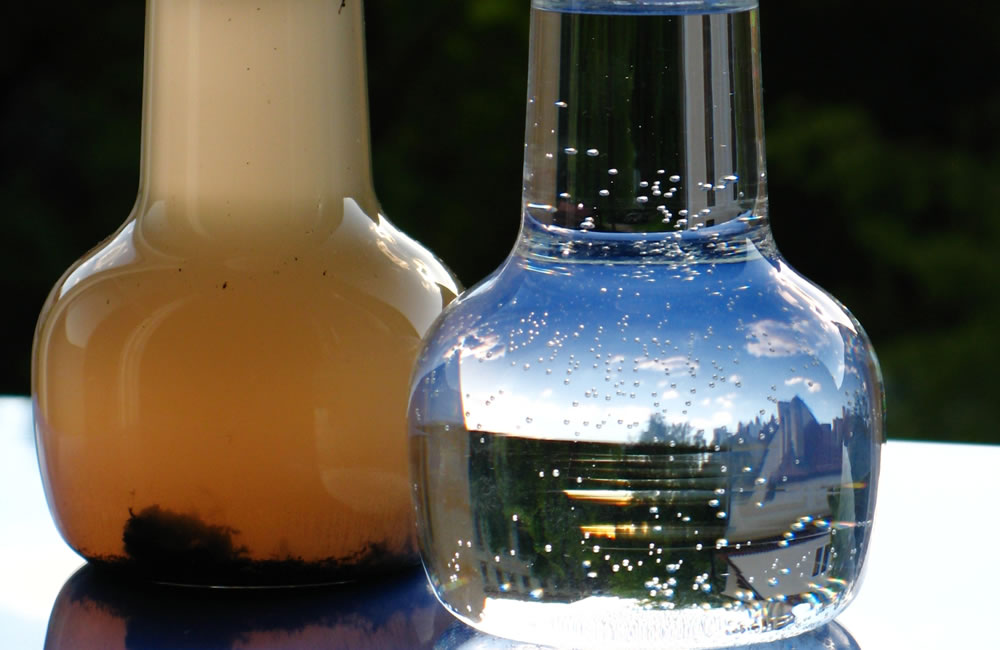
Turbidity isn’t one of those words which you’re likely to hear in everyday conversation. It’s one of those words which is common in the water treatment industry, where engineers will use it regularly and forget that it’s an unknown term for most of us. Although the term “turbidity” might seem very complex, all it really means is the level of cloudiness in water.
Cloudiness in water is usually caused by particles which get into the water system. These particles are then suspended in the water, and although they are too small to see individually, when present in large numbers they can make the water appear cloudy. These particles are usually oil, proteins, bacteria, dirt or algae.
How to measure turbidity in water?
Turbidity means more than just how cloudy or otherwise water is. Turbidity is also the way in which this cloudiness is measured, typically using an optical device which shows up these hidden particles in the water. A beam of light is used to shine through the sample, and then a measurement can be taken to calculate the number of particles in the water by the reduction in intensity of the beam. The higher the number of particles or the greater the concentration, then the higher the level of turbidity.
The two main types of turbidity detectors are:
What causes turbidity in water?
There’s nothing worse than turning on the tap for a refreshing glass of cold drinking water, and seeing cloudy liquid in the glass. It’s not the thirst-quenching drink you were hoping for, so most of us tip it into the sink and then let the tap run a bit longer before pouring another glass.
Contamination causing cloudiness in drinking water can be caused in a number of ways. Sometimes it is down to environmental contamination, and in other situations it is caused by human actions or behaviour. Chemicals such as phosphorus which are used in wastewater treatment or as agricultural fertilisers can get into the water supply, and lead to the unwanted growth of algae, which in turn leads to increased turbidity. In areas of the country with lots of bog or marsh areas, then the tannic acid from the soil can also cause discolouration or turbidity in the water too.
After periods of heavy rainfall, mud and silt can run off construction or agricultural sites into the water source. This causes an entirely natural process, but can also explain why turbidity in water does seem to fluctuate according to the time of year or the prevailing weather conditions.
Turbidity in water can cause damage to your taps or valves, and might also block up filters or pipework as well as causing contamination in any water storage tanks. The Environment Agency and other official bodies spend a lot of time and effort in monitoring agriculture and industrial practices to help them detect possible sources of contamination and pollution quickly.
What are the UK’s turbidity standards for drinking water?
The UK water industry aims to take steps to actively minimise turbidity in water, and ideally, get rid of it completely. This involves a range of treatment and water analysis processes which measure the quality of water at various stages of the distribution system to make sure everything is working properly. This also ensures that water companies are complying with all laws and regulations which are relevant.
The industry standard way of measuring turbidity is in nephelometric turbidity units or NTU.
UK guidelines state that drinking water at the tap should have a turbidity level below 4 NTU or less and this will appear clear. If the levels climb above 5 units, then this will usually be detected by users of the water supply. At 55 NTU the water will begin to look cloudy. Over 500 NTU and the water will appear completely opaque. If the water supply has had chlorine added, then again the turbidity levels should be less than 5, and preferably less than 1 NTU as this gives a good indication that the chlorination is working properly.
The link between chlorination and turbidity
In theory, adding chlorine as a disinfectant to water is a sure-fire way of reducing levels of turbidity in the water. In practice, it’s a bit trickier than that. If the water has very high levels of turbidity, this might interfere with the way in which the chlorine works. Even low levels of turbidity might stop the chlorine from working properly and prevent the chlorine from killing off the bacteria which might be in the cloudy water.
What are the best protocols to avoid and deal with turbidity in water?
Pre-filter gravel beds, coagulators or other products can all help address the potential risks of having high levels of turbidity in water. It is also a good idea to have a system for measuring and testing the water at various stages in the treatment process as this will help you identify “bottlenecks” in the system where you might want to prioritise cleaning or maintenance. Turbidity measurement is usually done using an electronic meter (Turbidimeter or Nephelometer), or by using a special turbidity tube, both of which will give you a result in NTU units mentioned earlier. Both of these ways of measuring turbidity have their own advantages and disadvantages.
Turbidity meters
Turbidity meters are often the preferred method when testing at very low levels, under 5 turbidity units. This is because the meters are very accurate at this level of turbidity. The disadvantage is that the meters can be very expensive, and have to be connected to either a mains power supply or a battery pack for operation.
Turbidity tubes
Turbidity tubes are much more cost-effective, and are robust pieces of measuring equipment. However, they are less precise than using a meter, and are not nearly as useful for measuring low levels of water turbidity.
Turbidity and suspended solids
There is definitely some common ground between measuring turbidity and also measuring total suspended solids, or TSS. However, TSS is usually measured by looking at the various solids suspended and the weights or mass of each, whereas turbidity is more about looking at the overall mass and the effect on water quality as a consequence.
Expert industrial wastewater treatment solutions
Water Treatment Services offer a comprehensive range of innovative water and wastewater management solutions for business. Our experts can provide advice and support to help you identify the most appropriate strategies for the identification, investigation and implementation of environmentally sensitive testing, monitoring and treatment solutions for industrial wastewaters and trade effluents.
With offices in London serving the South and South East England, Manchester (North West), Birmingham (Midlands), Bristol (South East England and Wales), Leeds (North and North East) and Glasgow (Scotland), supported by regional teams of specially trained engineers and wastewater treatment specialists we offer cost effective environmental support solutions across the whole of the UK and internationally.
Contact us today to learn how our wastewater solutions can help you reduce costs and improve environmental performance.