
• Link to X
  • Link to Facebook
  • Link to LinkedIn
  • Link to Mail
  • Call Me Back
  • About
  • Knowledge
📞 Call us on 0330 223 31 31
Water Treatment Services
  • Home
  • Water
    • Applications
      • Boiler Water Treatment Services
      • Cooling Water Treatment
      • Closed Loop Water Treatment
    • Services
      • Cooling Tower Cleaning Services UK
      • Cooling Tower Maintenance
      • Chlorine Dioxide Water Treatment Services
      • Commercial Water Softeners
      • Expert Witness Services
      • Pre-Commission Cleaning
      • Tank Reline & Repair
      • TMV Servicing
      • Water Chlorination & Disinfection
      • Water Leak Detection
      • Water Testing
        • Drinking Water Testing Services UK
        • Testing Water for Heavy Metals
        • Pool Water Testing
        • BSRIA Closed System Testing
        • SDI Testing & Analysis
        • Trade Effluent Testing
    • Training
      • Water Treatment Training
      • Basic Chemistry of Water
      • Industrial Treatment
      • Pre-Treatment
      • Boiler Treatment
      • Cooling Systems
      • Closed Systems
      • Wastewater Training
      • Advanced Treatments
      • Training Dates 2025
  • Wastewater
    • Testing Water for Heavy Metals
    • Trade Effluent Testing
    • Wastewater Training
    • Expert Witness Services
  • Chemicals
    • Water Treatment Chemicals
      • Boiler Water Treatment Chemicals
  • Air
    • Ductwork Cleaning
    • Indoor Air Quality
    • Local Exhaust Ventilation Testing
    • Mould Testing
    • Expert Witness Services
  • Energy
  • Contact
  • Click to open the search input field Click to open the search input field Search
  • Menu Menu
You are here: Home1 / Knowledge2 / Environment3 / 4 Tips to Maintain Good Swimming Pool Water Quality
4 tips for maintaining good swimming pool water quality.

4 Tips to Maintain Good Swimming Pool Water Quality

A swimming pool is one of the more challenging engineered water systems to maintain in a safe manner. Good maintenance involves both the inside and outside of the pool, along with the general pool area and the equipment involved. You also need to be sure the pool water quality meets minimum safety standards, as it’s likely lots of people will be using it throughout each day.

A swimming pool can potentially pose a big health hazard if it is not properly protected, cleaned, treated, and maintained regularly enough. As far as pool water quality goes, you need to be sure you attain the right balance of chemicals to inhibit the growth of waterborne pathogens such as Legionella, Pseudomonas and Cryptosporidium.

In this article, we’ll cover four important factors you should focus on to achieve and maintain the best water quality for your swimming pool.

    1. Maintaining the correct pool pH levels and alkalinity
    2. Optimising calcium hardness levels
    3. Total dissolved solids (TDS)
    4. Dealing with minerals that stain or discolour

1. Swimming pool water quality, pH levels and alkalinity

Typically, the pH level of your pool should be maintained between 7.0 and 7.4. (ideally 7.0 – 7.2) with a chlorine residual of 1.5 – 3mg/l (for all chlorine based disinfectants except cyanurates).

We can include alkalinity in this section as well, as it dovetails nicely with the pH element. If you achieve the best balance for the water in the pool, it should be able to resist an attempt to change the pH level. Chlorine is commonly used to sanitise pool waters, and if the alkalinity is measured somewhere between 80 and 200ppm (parts per million), you should be able to achieve this.

2. Optimising pool calcium hardness levels

The more calcium there is in the water in a swimming pool, the more likely it is you will see scale forming around the edges of the pool. It can also cause the water to become cloudy. Conversely, if the calcium levels drop too low, it can cause corrosion to fittings and fixtures within the pool. Therefore, it makes sense to visually check the water quality, check the sides of the pool for potential scale, and for signs of corrosion to any fixtures, fittings, and parts of the water system used in the pool.

You can treat unbalanced calcium levels by adding a sequestering agent (also known as a chelating agent) to the water. Ideally, you should aim for calcium levels of between 80 and 200ppm.

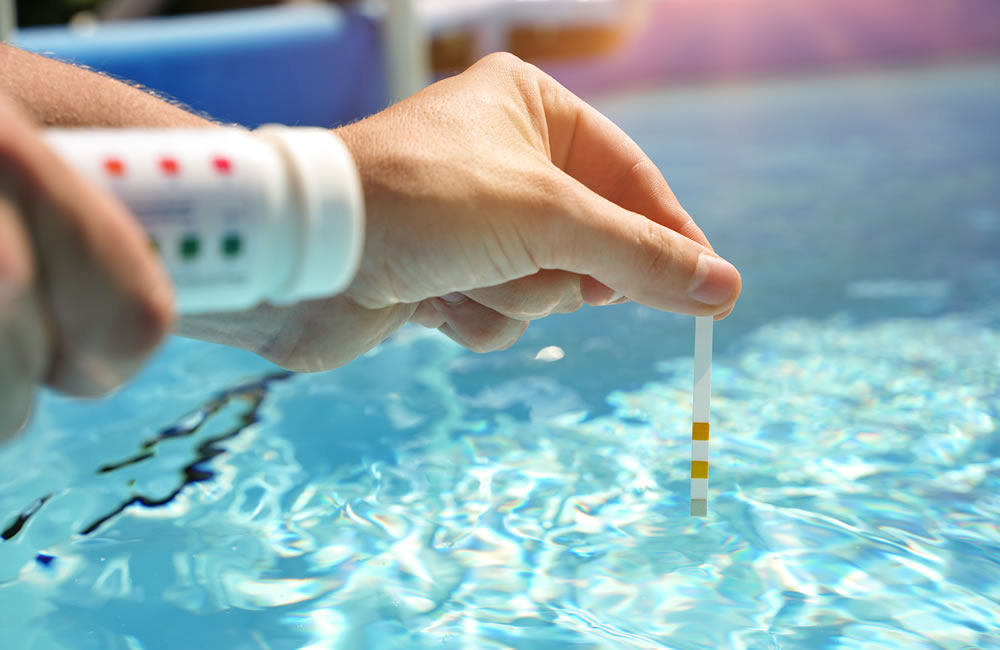
Swimming pool water quality test strips are a convenient way to test your pool water.

3. Levels of total dissolved solids (TDS) can affect water quality

This sounds horrific, but while dissolved solids can include contaminants we can leave to the imagination, they can also include the minerals we’re about to cover, and even salts.

When conducting a pool risk assessment, it is good practice to identify the TDS levels in the mains water supply feeding the pool. This is used as a baseline, whereby the TDS levels for the swimming pool should not be any higher than 1000ppm (parts per million) when considering the mains level. So, whatever you find is correct for the mains, you can work out the maximum safe level for the pool from there.

If the levels go higher than this amount, you may notice problems with water quality, foaming on the surface of the water, and difficulties in using a sanitiser to get the best results. Knowing the TDS for the pool therefore relies on understanding what’s in the mains water supply first.

Test Your Pool Water

4. Minerals that may discolour the water or stain the pool

Earlier we mentioned cloudy water caused by calcium, but it’s possible to have certain minerals in the water that can turn it different colours. Some minerals do this on their own, while others react with chemicals in the water. For example, copper can cause surfaces in contact with the water to go anywhere from green to blue to black. This includes people using the pool. It doesn’t cause cloudy water though, so if you find a green cloudy tinge has appeared, this would likely be caused by algae instead.

Another example is iron deposits in the water. These won’t cause any discoloration on their own, but when they encounter chlorine, they react and turn red or orange, causing the water and the surfaces to change colour.

You should take a proactive approach and focus on preventing such staining rather than combating it when it appears. The presence of such minerals should be highlighted as a potential risk when conducting a pool risk assessment. In many cases, the biggest risk for introducing minerals into the pool occurs when filling it with water. To this end, you may need to add a sequestrant to combat any unwanted mineral content when filling the pool. This should prevent any issues caused by staining pool surroundings or discolouring the water. While it may look fascinating, it can be difficult to remove any stains around the pool, so it’s better to make sure they’re not there to start with.

Managing your swimming pool water quality to keep it safe compliant with standards is essential.

Knowing the best levels for your own swimming pool

You can see that by knowing the best levels for various elements in the pool water will help you maintain those levels. You can test the water to determine whether it is within safe parameters. You can also proactively treat the water when adding it to the pool or when cleaning it. This will ensure the minerals, pH balance, and other factors are kept at their optimum levels, so good water quality is maintained, equipment life is extended and everyone using the pool can do so safely.

Expert pool water quality testing

Water Treatment Services offer a comprehensive range of water quality testing and laboratory analysis solutions to support owners and operators of swimming pools, spas and hot tubs. Our experts can provide advice and support to help you identify the most appropriate strategies for the on-going management of your pool facilities to keep them safe and in tip-top condition.

With offices in London serving the South and South East England, Manchester (North West), Birmingham (Midlands), Bristol (South East England and Wales), Leeds (North and North East) and Glasgow (Scotland), supported by regional teams of specially trained technicians, in-field specialists and consultants we can offer professional, cost effective water management and laboratory analysis solutions across the whole of the UK and internationally.

Contact us today to learn how our expert water management solutions can help keep your pool waters clean and safe to use.


Contact Us Today

Tags: Swimming pool water quality, Swimming Pool Water Testing, Swimming pools, Water testing
You might also like
Controlling legionella in hospitals and healthcare premises Controlling Legionella in Hospitals & Healthcare Premises
Food poisoning bacteria and viruses Food Poisoning Bacteria & Viruses – Symptoms, Treatment & Prevention
Mining wastewater treatment Mining Wastewater Treatment & Water Reuse
When to test for legionella When Should You Test For Legionella?
Sewage dumping and its impact on natural water quality Sewage Dumping and Its Impact on Natural Water Quality
Can Regular Flushing Control Legionella in Hot and Cold Water? Can Regular Flushing Control Legionella in Hot & Cold Water Systems?
What is rainwater harvesting? What is Rainwater Harvesting?
Natural water quality, pollution, its impact on human health and testing Natural Water Quality and Pollution: The Impact on Human Health and Testing

Search…

Search Search

What's New

  • Cooling Tower Compliance Check – Free Online Assessment

    Cooling Tower Compliance Check – Free Online Assessment

    How confident are you that your cooling tower management …
  • What are the 4 Main Methods for Treating Industrial Wastewater?

    What are the 4 Main Methods for Treating Industrial Wastewater?

    We all rely on water every day yet rarely …
  • Water Quality Assessment: 3 Key Areas for Safe Water Systems

    Water Quality Assessment: 3 Key Areas for Safe Water Systems

    Assessing water quality is a fundamental part of managing …
  • Water Quality Analysis for Modern Industries

    Water Quality Analysis for Modern Industries

    Understanding the quality of water used across modern industries …
  • Free Boiler Health Check & Boiler Water Treatment Assessment

    Free Boiler Health Check & Boiler Water Treatment Assessment

    Even small boiler water quality issues can lead to …
  • How to Clean and Maintain Reverse Osmosis Membranes

    How to Clean and Maintain Reverse Osmosis Membranes

    Reverse osmosis (RO) systems are relied upon to deliver …

REVIEWS

4.8
Water Treatment Services is rated 4.8 out of 5 stars (based on 103 reviews)
Read our reviews

Newsletter

Receive exciting features, news, latest research and special offers! Just add your email address and we'll do the rest.

Contact us

Water Treatment Services

[email protected]

Tel: 0330 223 31 31

© Copyright 2026 - EDG Ltd. Operating as Water Treatment Services
  • Link to X
  • Link to Facebook
  • Link to LinkedIn
  • Link to Mail
  • Home
  • About
  • Careers
  • Privacy
  • Environment
  • Reviews
  • Login[learndash_login login_label=”Login/Register” logout_label=”Logout”]
  • Sitemap
Link to: Is Your Legionella Risk Assessment Up to Standard? Link to: Is Your Legionella Risk Assessment Up to Standard? Is Your Legionella Risk Assessment Up to Standard?Is your Legionella risk assessment up to standard? Link to: Can IoT and AI Enhance Smart Water Management Technologies? Link to: Can IoT and AI Enhance Smart Water Management Technologies? Can IoT and AI Enhance Smart Water Management TechnologiesCan IoT and AI Enhance Smart Water Management Technologies?
Scroll to top Scroll to top Scroll to top

This site uses cookies. By continuing to browse the site, you are agreeing to our use of cookies.

OK

Cookie and Privacy Settings


How we use cookies

We may request cookies to be set on your device. We use cookies to let us know when you visit our websites, how you interact with us, to enrich your user experience, and to customize your relationship with our website.

Click on the different category headings to find out more. You can also change some of your preferences. Note that blocking some types of cookies may impact your experience on our websites and the services we are able to offer.

Essential Website Cookies

These cookies are strictly necessary to provide you with services available through our website and to use some of its features.

Because these cookies are strictly necessary to deliver the website, refusing them will have impact how our site functions. You always can block or delete cookies by changing your browser settings and force blocking all cookies on this website. But this will always prompt you to accept/refuse cookies when revisiting our site.

We fully respect if you want to refuse cookies but to avoid asking you again and again kindly allow us to store a cookie for that. You are free to opt out any time or opt in for other cookies to get a better experience. If you refuse cookies we will remove all set cookies in our domain.

We provide you with a list of stored cookies on your computer in our domain so you can check what we stored. Due to security reasons we are not able to show or modify cookies from other domains. You can check these in your browser security settings.

Google Analytics Cookies

These cookies collect information that is used either in aggregate form to help us understand how our website is being used or how effective our marketing campaigns are, or to help us customize our website and application for you in order to enhance your experience.

If you do not want that we track your visit to our site you can disable tracking in your browser here:

Other external services

We also use different external services like Google Webfonts, Google Maps, and external Video providers. Since these providers may collect personal data like your IP address we allow you to block them here. Please be aware that this might heavily reduce the functionality and appearance of our site. Changes will take effect once you reload the page.

Google Webfont Settings:

Google Map Settings:

Google reCaptcha Settings:

Vimeo and Youtube video embeds:

Other cookies

The following cookies are also needed - You can choose if you want to allow them:

Privacy Policy

You can read about our cookies and privacy settings in detail on our Privacy Policy Page.

Privacy
Accept settingsHide notification only