• Link to X
  • Link to Facebook
  • Link to LinkedIn
  • Link to Mail
  • Call Me Back
  • About
  • Knowledge
📞 Call us on 0330 223 31 31
Water Treatment Services
  • Home
  • Water
    • Applications
      • Boiler Water Treatment Services
      • Cooling Water Treatment
      • Closed Loop Water Treatment
    • Services
      • Cooling Tower Cleaning Services UK
      • Cooling Tower Maintenance
      • Chlorine Dioxide Water Treatment Services
      • Commercial Water Softeners
      • Expert Witness Services
      • Pre-Commission Cleaning
      • Tank Reline & Repair
      • TMV Servicing
      • Water Chlorination & Disinfection
      • Water Leak Detection
      • Water Testing
        • Drinking Water Testing Services UK
        • Testing Water for Heavy Metals
        • Pool Water Testing
        • BSRIA Closed System Testing
        • SDI Testing & Analysis
        • Trade Effluent Testing
    • Training
      • Water Treatment Training
      • Basic Chemistry of Water
      • Industrial Treatment
      • Pre-Treatment
      • Boiler Treatment
      • Cooling Systems
      • Closed Systems
      • Wastewater Training
      • Advanced Treatments
      • Training Dates 2025
  • Wastewater
    • Testing Water for Heavy Metals
    • Trade Effluent Testing
    • Wastewater Training
    • Expert Witness Services
  • Chemicals
    • Water Treatment Chemicals
      • Boiler Water Treatment Chemicals
  • Air
    • Ductwork Cleaning
    • Indoor Air Quality
    • Local Exhaust Ventilation Testing
    • Mould Testing
    • Expert Witness Services
  • Energy
  • Contact
  • Click to open the search input field Click to open the search input field Search
  • Menu Menu
You are here: Home1 / Water2 / Boiler Water Treatment Services

Industrial Boiler Water Treatment Services for Commercial & Steam Generating Systems
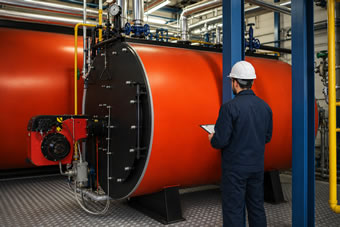
WTS boiler water treatment services engineer inspecting large steam boiler located in plant room

Water Treatment Services provide specialist boiler water treatment services to industrial and commercial organisations.

After many years working with commercial and industrial steam boilers, one thing has become very clear to us. Most serious boiler problems don’t happen overnight, and very few are unavoidable. In the majority of cases, there are warning signs long before a boiler tube fails or a system is taken out of service. Unfortunately, those warning signs are often missed, ignored or simply not recognised for what they are.

We’ve investigated boilers with severe internal scale where fuel consumption had been creeping upwards for years. We’ve seen condensate lines almost completely blocked with corrosion products and feed tanks suffering oxygen attack because they had been left open to atmosphere. In many cases, the boiler chemistry wasn’t the root cause at all. More often than not, the problem was a loss of control.

Good boiler water treatment isn’t simply about adding chemicals. It’s about understanding how a steam system behaves, maintaining stable water conditions and identifying problems before they become expensive.

Water Treatment Services provide specialist boiler water treatment services and high-performance chemicals for commercial and industrial steam systems throughout the UK and Ireland. Our treatment programmes are developed in accordance with BG04 guidance and are designed to help clients maintain efficient, reliable and safe steam generation.

No two boiler systems are the same. Water quality, operating pressures, steam demand, condensate return rates and even operator experience all influence the way a system behaves. That’s why we don’t believe in standard treatment programmes. In our experience, the best results are achieved by understanding the plant and developing a boiler water treatment programme around the conditions that exist on site.

Good boiler water treatment isn’t simply about adding chemicals. It’s about understanding how a steam system behaves, maintaining stable water conditions and identifying problems before they become expensive.

Why Does Boiler Water Treatment Matter?

Steam boilers are expensive pieces of plant. They consume large amounts of energy and, in many industries, production depends upon them operating reliably.

Yet poor water quality remains one of the most common causes of boiler problems.

That’s not just our opinion. It’s something we’ve seen repeatedly during boiler investigations and system surveys carried out across manufacturing sites, hospitals, food production facilities, universities and commercial buildings.

The frustrating part is that many of these problems are entirely preventable.

A properly controlled boiler treatment programme helps:

  • Check Check

    Maintain energy efficiency

  • Check Check

    Reduce fuel costs

  • Check Check

    Protect boilers & associated plant

  • Check Check

    Improve steam quality

  • Check Check

    Reduce breakdowns & unplanned downtime

  • Check Check

    Extend equipment life

  • Check Check

    Support compliance with BG04 & BS 2486

Compared with the cost of replacing tubes, repairing condensate systems or losing production, effective boiler water treatment represents a relatively small investment.

Talk to a Boiler Specialist

What Happens When Water Quality Is Lost?

It’s important to remember that water doesn’t have to be visibly dirty to cause problems.

In fact, some of the worst cases we’ve encountered involved systems that appeared perfectly normal from the outside.
  • Attention Attention

    Scale Formation

    Scale remains one of the biggest enemies of efficient steam generation.

    When hardness minerals (calcium and magnesium) are allowed to enter the boiler, they deposit onto heat transfer surfaces and act as an insulator. The boiler then has to work harder and consume more fuel to produce the same amount of steam.

    We’ve seen boilers where only a few millimetres of scale have increased fuel consumption significantly. In one case, operators were convinced the burner was at fault when the real problem was poor softener performance.

    Even 1 mm of scale can increase fuel consumption by 7-10%. That might not sound much, but over the course of a year the additional energy costs can be substantial.

    Scale also increases the risk of localised overheating and tube failure.

  • Attention Attention

    Corrosion

    Corrosion is often less obvious than scale, but it can be every bit as damaging.

    We’ve investigated water systems where condensate pipework had become paper thin without anyone realising there was a problem. In other cases, oxygen attack had caused severe pitting inside feed tanks and boiler tubes.

    Corrosion usually develops slowly. That’s one reason it’s so dangerous. By the time leaks appear, the damage has often been occurring for years.

  • Attention Attention

    Sludge & Deposits

    Sludge is another issue that tends to be underestimated.

    Corrosion products, suspended solids and hardness deposits can accumulate within the system and settle out in areas of low circulation.

    These deposits restrict heat transfer and can create conditions that promote under-deposit corrosion.

    One of the things we often find during inspections is that systems which have received plenty of chemical treatment have actually suffered because the deposits themselves were never properly removed.

  • Attention Attention

    Carryover & Foaming

    Poor steam quality can cause problems far beyond the boiler house.

    Carryover and foaming can result in water droplets and dissolved solids being carried over into the steam system. This can affect heat exchangers, control valves and process equipment.

    In food production and pharmaceutical applications, poor steam quality can have serious consequences.

    Fortunately, these issues are usually preventable with good control and regular monitoring.

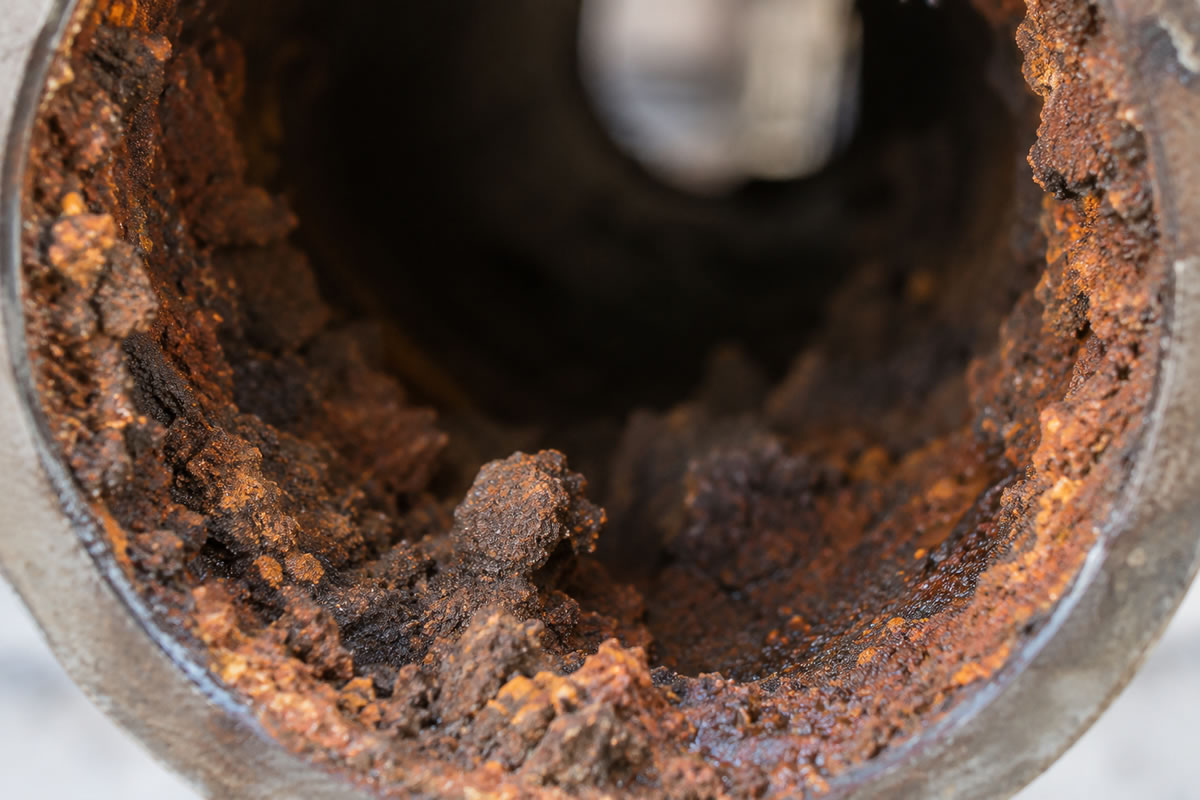
Extensive internal corrosion to internal steam boiler pipework surfaces

| Extensive internal corrosion to internal steam boiler pipework surfaces

How Much Can Poor Water Treatment Cost?

Most people only think about the cost of treatment chemicals.

From our experience, that’s looking at the problem from the wrong end.

The real question should be:

“What does poor water treatment cost?”

In practice, we’ve seen:

  • Boilers consuming thousands of pounds of additional fuel because of scale.
  • Tube failures requiring expensive repairs and unexpected downtime.
  • Condensate return systems replaced prematurely because of corrosion.
  • Excessive blowdown wasting huge volumes of heated water.
  • Production interruptions caused by unreliable steam quality.
  • Heat exchangers and valves damaged by carryover.

Compared with these costs, maintaining an effective water treatment programme is relatively inexpensive.

Common Problems We Encounter During Boiler Surveys

Although every site is different, certain issues crop up time and time again.

Some of the most common findings include:

  • Water softeners that are no longer regenerating correctly.
  • Failed dosing pumps.
  • Incorrect sampling procedures.
  • Excessive blowdown rates.
  • Feed tanks open to atmosphere.
  • Poor condensate return quality.
  • Boiler water chemistry outside recommended limits.
  • Operators relying on historical settings that haven’t been reviewed for years.
  • Inadequate monitoring.
  • Lack of understanding following changes in personnel.

Interestingly, the chemistry itself is rarely the problem.

In our experience, most failures result from a gradual loss of control rather than the use of the wrong product.

Warning Signs Your Boiler Water Treatment Programme Needs Attention

Many steam systems continue operating while water quality slowly deteriorates.

Some of the warning signs to look out for include:

  • Attention Attention

    Rising fuel consumption

  • Attention Attention

    Increasing chemical usage

  • Attention Attention

    Dirty gauge glasses

  • Attention Attention

    Frequent boiler alarms

  • Attention Attention

    Excessive blowdown

  • Attention Attention

    Reduced steam output

  • Attention Attention

    Corrosion around condensate lines

  • Attention Attention

    Unusual boiler water test results

  • Attention Attention

    Increasing maintenance requirements

  • Attention Attention

    Wet steam & carryover problems

Is Your Boiler Operating at Peak Performance?

Find out with our free boiler health check…

How confident are you that your boiler system is operating at peak performance? Even small water quality issues can lead to scale formation, corrosion, reduced efficiency, increased fuel consumption and costly breakdowns.

Answer 15 quick questions (time to complete is only 3-5 minutes) to discover how healthy your boiler system is and identify opportunities to improve efficiency, reliability and lifespan.

Boiler Health Check

Why Boiler Water Treatment Programmes Fail

After many years investigating steam systems, we’ve come to the conclusion that treatment programmes rarely fail because of poor chemistry.

More often, the causes are much simpler:

  • Poor monitoring.
  • Neglected water softeners.
  • Faulty dosing equipment.
  • Changes in operating conditions.
  • Loss of condensate return.
  • Lack of communication.
  • Infrequent testing.
  • Loss of knowledge when experienced personnel retire or move on.

Good boiler water treatment isn’t complicated, but it does require consistency.

Maintaining control is far more important than chasing numbers or adding ever-increasing amounts of chemicals.

Nationwide Boiler Water Treatment Services Across the UK and Ireland

Water Treatment Services supports clients throughout the UK and Ireland, with offices in London, Manchester, Birmingham, Bristol, Leeds and Glasgow.

Our engineers work with organisations operating everything from small shell boilers through to large steam generating plant serving manufacturing, healthcare, food production, pharmaceutical, energy and commercial sectors.

Whatever the application, our approach remains the same.

  • Understand the system.
  • Identify the risks.
  • Maintain control.
  • And prevent problems before they become expensive.
Talk to a Boiler Specialist

Our Boiler Water Treatment Services

Over the years, we’ve come to the conclusion that successful boiler water treatment has very little to do with simply selling chemicals and everything to do with maintaining control.

Most systems don’t fail because someone chose the wrong oxygen scavenger or phosphate treatment. More often than not, problems develop because the basics have been overlooked. A softener stops regenerating. A dosing pump fails. Boiler water tests are no longer being carried out. Or perhaps the steam demand has changed and the original treatment programme has simply never been reviewed.

In many cases, the warning signs have been there for months.

That’s why our approach has always been based around understanding the system first and then developing a treatment programme that suits the way the plant actually operates.
  • Check Check

    Water Analysis & Boiler System Surveys

    Good water treatment starts with good information.

    One of the first things we do during a site survey is to look at the fundamentals, asking a few basic questions.

    • Is the softener operating correctly?
    • Are sample coolers fitted?
    • Are operators carrying out routine tests?
    • What is the quality of the condensate return?
    • Has the boiler load changed since the original treatment programme was introduced?

    These questions often tell us far more than the laboratory analysis alone.

    We’ve been involved in surveys where expensive boiler problems have ultimately been traced back to something as simple as a failed conductivity controller or a softener that had quietly stopped regenerating months earlier.

    It happens more often than people might think.

    Our surveys typically include:

    • Boiler water analysis.
    • Feedwater analysis.
    • Condensate quality assessment.
    • Review of dosing arrangements.
    • Assessment of blowdown control.
    • Inspection of pre-treatment plant.
    • Evaluation of system operating conditions.
    • Review of existing water treatment records.

    The aim isn’t simply to identify problems. It’s to understand why they’re occurring and prevent them from happening again.

  • Check Check

    Bespoke Boiler Water Treatment Programmes

    No two steam systems behave in exactly the same way.

    A water treatment programme that works perfectly on one site may be completely unsuitable for another.

    That’s something we’ve seen repeatedly over the years.

    Factors such as:

    • Boiler pressure.
    • Steam demand.
    • Feedwater quality.
    • Condensate return percentage.
    • Pre-treatment equipment.
    • Operating practices.

    … all influence the chemistry requirements.

    For that reason, we develop boiler treatment programmes around the system rather than trying to make the system fit the chemistry.

    Depending on the application, treatment may include:

    Oxygen Scavengers

    To remove dissolved oxygen and minimise corrosion.

    Phosphate Treatments

    To help prevent hardness deposits and maintain internal cleanliness.

    Alkalinity Builders

    To maintain stable water conditions and protect metal surfaces.

    Polymer Dispersants

    To keep sludge and suspended solids mobile so they can be removed through blowdown.

    Condensate Line Protection

    To reduce corrosion within condensate return systems.

    In practice, good chemistry is about maintaining balance rather than adding excessive quantities of chemicals.

    We’ve always believed that stable control is more important than chasing individual test results.

  • Check Check

    Dosing & Control Equipment

    Even the best chemistry in the world won’t work if it isn’t being applied properly.

    Failed pumps, blocked injection points and faulty conductivity controllers are all things we regularly encounter during site visits.

    In fact, some of the worst cases of internal corrosion we’ve investigated have occurred not because the chemistry was wrong, but because the treatment simply wasn’t reaching the system.

    We supply and maintain high-quality equipment including:

    • Chemical dosing systems.
    • Conductivity controllers.
    • Blowdown control equipment.
    • Water meters.
    • Sample coolers.
    • Monitoring systems.
    • Dosing tanks and associated equipment.

    Reliable dosing equipment helps maintain consistent water conditions and reduces unnecessary chemical consumption.

  • Check Check

    Boiler Water Testing & Monitoring

    Boiler water treatment is not something that can be set up and forgotten.

    Conditions change.

    Steam loads vary.

    Water quality changes.

    Equipment ages.

    That’s why regular water testing remains one of the most important aspects of any treatment programme.

    In our experience, the systems that perform best are not necessarily those using the most sophisticated chemistry. They’re the ones where somebody is paying attention.

    Routine monitoring allows problems to be identified before they become serious.

    We provide:

    • On-site testing.
    • Laboratory analysis.
    • Trend analysis.
    • Technical reporting.
    • Recommendations for improvement.
    • Support with BG04 compliance.

    Trend analysis is particularly valuable.

    Individual test results only tell you what is happening today.

    Trends tell you where the system is heading.

  • Check Check

    Blowdown & Efficiency Optimisation

    Our engineers have visited sites where thousands of litres of perfectly good, chemically treated water were being discharged every day simply because nobody had reviewed the control settings for years.

    Every litre of water discharged represents:

    • Water.
    • Heat.
    • Treatment chemicals.
    • Energy.
    • Waste.

    In effect, money is literally being poured down the drain.

    Optimising blowdown rates helps maintain boiler water quality while minimising unnecessary losses.

    On larger steam generating systems, relatively small improvements can deliver significant savings over the course of a year.

  • Check Check

    Focussing on Continuous Improvement

    One thing we’ve all learnt after many years working with steam systems is that boilers rarely stand still.

    Production requirements change.

    Plant is modified.

    Condensate return rates vary.

    Water quality changes.

    As a result, treatment programmes need to evolve.

    Our involvement doesn’t stop once the initial programme has been implemented.

    Regular reviews allow us to:

    • Identify emerging problems.
    • Improve efficiency.
    • Reduce chemical consumption.
    • Extend equipment life.
    • Minimise risk.
    • Improve reliability.

    In many cases, small adjustments made early can prevent much larger problems developing later.

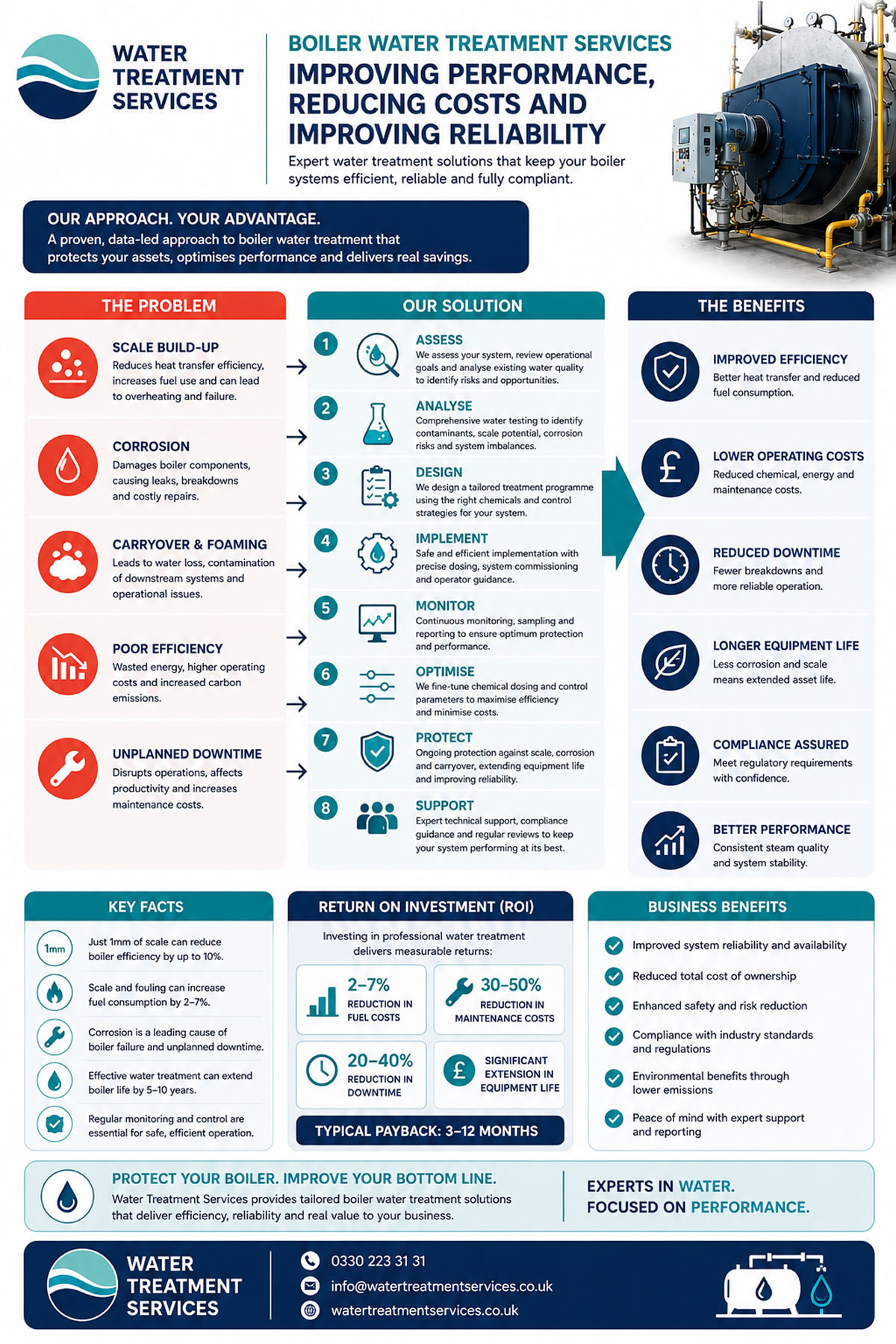
Diagram explaining Water Treatment Services approach to the management of industrial steam boiler systems highlighting the problems, solutions and benefits

Why Good Chemistry Alone Isn’t Enough

This is probably one of the strongest opinions we’ve formed over the years.

Good boiler water treatment isn’t really about chemicals.

Understanding the chemistry is only one part of the picture.

We’ve seen systems running successfully with fairly straightforward treatment programmes because operators maintained good control and monitored conditions properly.

Equally, we’ve investigated boilers suffering severe scaling and corrosion despite using premium water treatment products.

The difference almost always comes down to management and control making boiler operator training and competence all the more important.

Often, the key ingredients of successful boiler water treatment are:

  • Good pre-treatment.
  • Reliable dosing equipment.
  • Regular testing.
  • Competent operators.
  • Practical engineering support.
  • Ongoing review.

And perhaps most importantly, a willingness to address small problems before they become expensive ones.

Because, when it comes to steam systems, prevention is almost always cheaper than repair.

Components of an Effective Boiler Water Treatment Programme

After many years working with steam systems, we’ve become convinced that successful boiler water treatment starts long before the water reaches the boiler.

In fact, some of the worst scaling and corrosion problems we’ve investigated have had very little to do with the treatment chemicals themselves. More often than not, the root cause has been poor feedwater quality, inadequate pre-treatment or a gradual loss of control.

That’s why we’ve always viewed boiler water treatment as a complete system rather than a collection of chemicals.

Good steam generation depends on maintaining stable conditions from the incoming mains water all the way through to the condensate returning to the feed tank.

If one part of that chain fails, problems usually follow.

  • Check Check

    Feedwater Treatment

    Feedwater quality has a direct influence on efficiency, reliability and operating costs.

    Hardness salts, dissolved oxygen and other contaminants entering the boiler eventually become someone else’s problem.

    The unfortunate reality is that boilers are very unforgiving pieces of plant. They will tolerate poor water quality for a while, but eventually the consequences catch up.

    We’ve lost count of the number of times we’ve heard:

    “The boiler’s been running like that for years.”

    In many cases, that’s true.

    But problems that develop slowly are often the most expensive when they finally come to light.

    Proper feedwater treatment helps:

    • Reduce scaling.
    • Minimise corrosion.
    • Improve steam quality.
    • Lower fuel consumption.
    • Extend boiler life.

    In our experience, money spent on good feedwater treatment is money well spent.

  • Check Check

    Water Softeners

    If we had to identify the single biggest cause of scale problems, it would probably be poorly maintained water softeners.

    Time and again, site investigations reveal softeners that have stopped regenerating correctly, exhausted resin beds or control valves that have been bypassed or isolated.

    Because boilers continue to produce steam, operators often assume everything is fine.

    Meanwhile, hardness is quietly entering the system.

    By the time the problem becomes obvious, scale may already be affecting efficiency.

    Water softeners remove calcium and magnesium salts before they enter the boiler.

    For many steam systems, they provide the first and arguably the most important line of defence.

    Well-maintained ion-exchange water softeners can save thousands of pounds in fuel and maintenance costs over its lifetime.

    Neglect it, and the consequences can be surprisingly expensive.

  • Check Check

    Reverse Osmosis

    Where higher purity water is required, reverse osmosis systems can provide a significant improvement in feedwater quality.

    By removing dissolved solids and impurities, reverse osmosis reduces the burden placed on the boiler and allows higher cycles of concentration to be achieved.

    This generally means:

    • Reduced blowdown.
    • Lower chemical consumption.
    • Improved steam quality.
    • Better overall efficiency.

    The benefits are often most noticeable on larger steam systems.

    On some sites we’ve investigated, installing reverse osmosis has reduced blowdown volumes dramatically, delivering worthwhile savings in water, energy and treatment costs.

    Reverse Osmosis Chemicals

    Reverse osmosis systems also require protection.

    Membranes are expensive and, like boilers, they don’t respond well to neglect.

    The most common RO chemicals we use include:

    Antiscalants

    These help prevent mineral deposits from forming on membrane surfaces.

    Membrane Cleaning Chemicals

    Used to remove fouling and restore membrane performance.

    Biocides

    Designed to control biological contamination and prevent microbiological growth.

    pH Correction Chemicals

    Used to optimise operating conditions and protect membrane materials.

    Dechlorination Chemicals

    Used to remove chlorine and prevent damage to sensitive membranes.

    In practice, membrane fouling often develops gradually.

    By the time operators notice falling production rates, performance may have been deteriorating for months.

    Regular monitoring and cleaning can make a huge difference to membrane life.

  • Check Check

    Deaeration

    Dissolved oxygen is one of the most destructive contaminants found in boiler feedwater.

    Unlike scale, oxygen attack is often hidden from view until serious damage has already occurred.

    We’ve investigated feed tanks showing severe pitting where the system had been operating quite happily for years.

    At least, that’s what everyone thought.

    Mechanical deaeration removes oxygen and other gases before the water enters the boiler.

    Combined with chemical oxygen scavengers, it provides essential protection against corrosion.

    From our experience, deaeration equipment is sometimes overlooked because it’s quietly doing its job in the background.

    When it’s working properly, nobody notices.

    When it isn’t, the consequences can be severe.

  • Check Check

    Oxygen Scavengers

    Even the best deaerators leave behind traces of dissolved oxygen.

    Oxygen scavengers provide an additional layer of protection.

    Products such as sulphites and tannin-based treatments remove residual oxygen and help safeguard the boiler, feed system and condensate return network.

    Selecting the correct oxygen scavenger depends on:

    • Boiler pressure.
    • Operating conditions.
    • Feedwater quality.
    • Steam purity requirements.

    Unfortunately there is no universal answer.

    That’s one reason why we don’t believe in standard off-the-shelf chemical programmes.

    Every steam system has its own characteristics and treatment needs to reflect that.

  • Check Check

    Internal Chemical Treatment

    The purpose of internal chemical treatment is straightforward.

    Maintain water conditions that prevent scale and corrosion while keeping deposits suspended so they can be removed by blowdown.

    Typical treatment products include:

    • Oxygen scavengers.
    • Phosphate treatments.
    • Alkalinity builders.
    • Polymer dispersants.
    • Condensate line inhibitors.

    The chemistry itself is important, but maintaining stable control is even more important.

    We’ve seen systems running successfully with relatively simple treatment programmes because they were monitored properly.

    Conversely, we’ve seen expensive chemistry fail because no one was checking the results.

    Good treatment isn’t about adding more chemicals.

    It’s about maintaining balance.

  • Check Check

    Condensate Treatment

    One of the biggest misconceptions in boiler water treatment is that the boiler itself is where all the problems occur.

    Some of the worst corrosion we’ve investigated has actually been found in condensate return systems.

    Pipework hidden above ceilings or beneath plant room floors can quietly deteriorate for years before leaks appear.

    Carbon dioxide dissolved in condensate forms weak carbonic acid.

    Over time, this attacks return pipework and associated equipment.

    Condensate treatment helps protect:

    • Return lines.
    • Feed tanks.
    • Condensate receivers.
    • Heat exchangers.

    Maintaining condensate quality also improves the quality of water returning to the boiler.

    It’s an area that’s often overlooked, but one that can have a major influence on reliability.

  • Check Check

    Blowdown Control

    Boiler blowdown control is necessary.

    Excessive blowdown isn’t.

    That’s something we’ve seen repeatedly during site surveys.

    Many systems are losing far more heat, water and treatment chemicals than they need to.

    As steam is produced, dissolved solids become concentrated within the boiler.

    Blowdown removes these impurities and maintains water quality.

    When correctly controlled, blowdown:

    • Maintains stable TDS levels.
    • Reduces the risk of carryover.
    • Protects steam quality.
    • Preserves boiler efficiency.

    When poorly controlled, it wastes energy and money.

    In some cases, simply reviewing blowdown practices has delivered noticeable savings without changing the treatment chemistry at all.

Why the Boiler Is Only Part of the Steam Generating System

One thing we’ve learnt working with steam systems is that boilers rarely fail in isolation.

Problems often start elsewhere.

A softener stops regenerating.

Condensate quality deteriorates.

A dosing pump fails.

A feed tank is left open.

Nobody reviews the test results.

Individually, these may appear to be small issues.

Collectively, they can lead to major problems.

That’s why effective boiler water treatment should always be viewed as a whole-system approach.

Because the boiler itself is only one part of the story.

And in our experience, the best results are achieved when the entire steam system is considered rather than focusing solely on the boiler house.
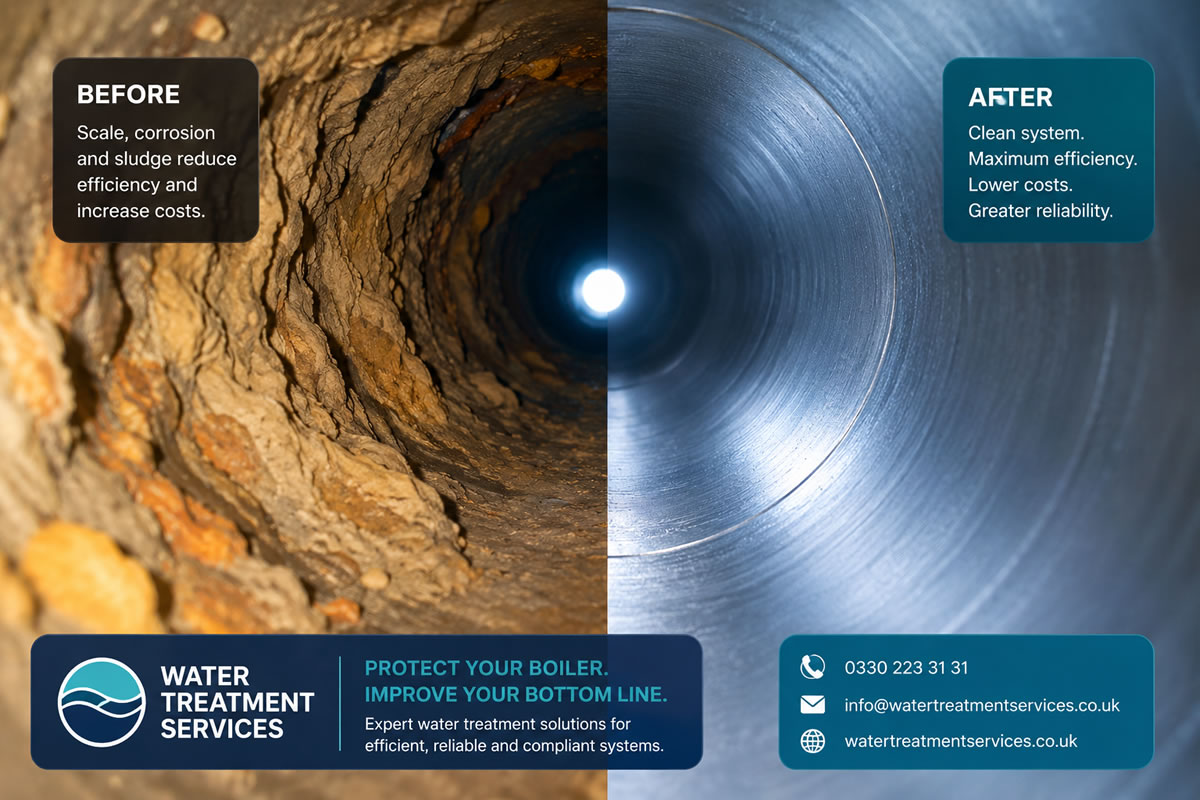
Before and after photo showing heavily scaled steam boiler pipework

The Benefits of Effective Boiler Water Treatment

People often think of boiler water treatment as a cost.

We’ve always looked at it slightly differently.

Good water treatment isn’t really an expense. It’s an investment in the reliability and efficiency of some very expensive pieces of plant.

Over the years, we’ve investigated steam systems where relatively minor water quality problems have resulted in substantial repair costs. Equally, we’ve seen well-maintained boilers continue operating reliably for decades because somebody took water treatment seriously.

Most of the benefits are not dramatic. They’re incremental.

Reduced fuel consumption here.

Less maintenance there.

Fewer breakdowns.

Longer equipment life.

Individually, these improvements may appear small. Taken together, they can make a considerable difference.

  • Check Check

    Reduced Fuel Costs & Improved Efficiency

    In our experience, energy efficiency is often where the biggest financial gains are made.

    Steam boilers consume a lot of energy. Anything that interferes with heat transfer will increase fuel consumption.

    Scale is particularly unforgiving.

    Even relatively thin deposits can have a surprisingly large impact.

    One millimetre of scale can increase fuel usage by between 7 and 10%.

    That figure often catches people by surprise.

    We’ve investigated systems where rising gas consumption was initially blamed on burners or controls, only to discover that the underlying issue was hardness leakage through a softener.

    The chemistry wasn’t wrong.

    The softener had simply stopped doing its job.

    Maintaining clean heat transfer surfaces remains one of the simplest and most effective ways of improving boiler efficiency.

  • Check Check

    Fewer Breakdowns & Improved Reliability

    Most major failures don’t happen suddenly.

    They develop gradually.

    Corrosion takes time.

    Scale builds up over months or years.

    Sludge accumulates slowly.

    One of the advantages of maintaining good water quality is that these problems can often be prevented long before they affect production.

    Reliable steam systems rarely attract attention.

    People only tend to notice them when they stop working.

    Our experience has been that the most reliable plants are usually those with:

    • Consistent monitoring.
    • Well-maintained softeners.
    • Stable chemistry.
    • Competent operators.
    • Regular reviews.

    Good water treatment won’t eliminate every breakdown, but it can significantly reduce the risk of avoidable failures.

  • Check Check

    Longer Equipment Life

    Steam boilers represent a significant investment.

    So do feed tanks, pipework, heat exchangers, valves and condensate systems.

    Given the cost of replacement, it makes sense to protect them.

    We’ve encountered boilers still operating efficiently after several decades because water quality had been maintained properly.

    Conversely, we’ve investigated systems requiring extensive repairs after only a fraction of that time because treatment had been neglected.

    In our opinion, one of the best measures of a successful treatment programme is how quietly the plant goes about its job year after year.

  • Check Check

    Better Steam Quality

    Poor steam quality causes problems far beyond the boiler house.

    Carryover and contamination can affect:

    • Heat exchangers.
    • Control valves.
    • Process equipment.
    • Humidification systems.
    • Sterilisers.
    • Steam users throughout the site.

    In food production, pharmaceutical manufacturing and healthcare environments, steam quality can be critical.

    Good boiler water treatment helps maintain stable conditions and reduce the risk of carryover and foaming.

  • Check Check

    Reduced Maintenance Costs

    Maintenance costs are often affected by poor water quality in ways that aren’t immediately obvious.

    Leaking condensate lines.

    Premature valve failures.

    Blocked strainers.

    Tube repairs.

    Heat exchanger fouling.

    We’ve seen sites spend significant sums replacing components without ever addressing the underlying cause.

    Water treatment doesn’t eliminate maintenance, but it can help prevent many avoidable problems.

  • Check Check

    Improved Safety

    Steam systems deserve respect.

    High pressures and temperatures mean the consequences of failure can be serious.

    Fortunately, catastrophic failures are rare.

    But from experience, many serious incidents are preceded by smaller warning signs.

    Corrosion.

    Scaling.

    Poor water chemistry.

    Carryover.

    Loss of control.

    Maintaining good water quality helps support safer and more reliable operation.

    Ultimately, prevention is always preferable to dealing with the consequences of failure.

  • Check Check

    Reduced Environmental Impact

    Improving efficiency doesn’t just reduce operating costs.

    It also reduces energy consumption and associated carbon emissions.

    Optimised blowdown, improved heat transfer and better steam quality all contribute to more sustainable operation.

    Although environmental considerations are becoming increasingly important, we’ve found that the most effective sustainability measures are often those that make sound engineering sense in the first place.

  • Check Check

    Better Compliance

    Good boiler water treatment supports compliance with:

    • BG04 Guidance.
    • BS 2486.
    • Internal quality systems.
    • Insurance requirements.
    • Site operating procedures.

    But in our view, compliance should never be the only objective.

    Following good practice isn’t simply about satisfying auditors.

    It’s about protecting people, equipment and production.

Boiler Water Treatment Return on Investment

Clients occasionally ask us whether water treatment really delivers a return.

Our answer is usually the same.

Look at the alternatives!

Scale and Fuel Costs

One millimetre of scale can increase fuel consumption by 7-10%.

For larger steam users, that can amount to many thousands of pounds each year.

Excessive Blowdown

We’ve visited sites where perfectly good treated water was being discharged unnecessarily.

Optimising blowdown alone has delivered worthwhile savings without changing the chemistry.

Condensate Corrosion

Hidden condensate lines can quietly deteriorate for years.

Replacing corroded pipework is rarely cheap and often disruptive.

Protecting condensate systems usually costs far less than replacing them.

Tube Failures

Few repairs are more inconvenient than a boiler tube failure.

Lost production, emergency repairs and downtime can quickly outweigh the annual cost of treatment.

Our 7 Step Approach to Boiler Water Treatment

You might be surprised to learn that we believe good boiler water treatment isn’t complicated.

The principles are actually quite straightforward.

Understand the system.

Maintain control.

Monitor what matters.

And deal with small problems before they become large ones.

That might sound obvious, but in practice it’s surprising how many failures occur because one of those basic principles has been lost somewhere along the way.

We’ve always believed that boiler water treatment should be driven by engineering rather than chemistry.

Chemicals are important, of course, but they are only one part of the picture.

The most successful sites are rarely those using the most sophisticated products.

They’re usually the sites that understand their systems, monitor them properly and maintain good operating practices.

That’s the philosophy we’ve always tried to follow at Water Treatment Services.

Step 1 – Boiler System Survey and Assessment

Every project starts with understanding what we’re dealing with.

As a business we’ve never been great believers in recommending treatment without first seeing the system and understanding how it operates.

There are simply too many variables.

Over the years, we’ve learnt that assumptions can be expensive.

During an initial survey we’ll typically look at:

    • Boiler type and operating pressures.
    • Feedwater arrangements.
    • Water softeners and pre-treatment plant.
    • Feed tanks and deaeration.
    • Condensate return rates.
    • Existing chemical treatment.
    • Blowdown arrangements.
    • Sampling facilities.
    • Monitoring procedures.
    • Historical records and water analysis.

One of the questions we often ask operators is:

“When was the last time anybody really reviewed the system?”

Quite often, nobody can remember.

And that’s understandable.

Boilers tend to sit quietly in the background doing their job.

Until they don’t.

Step 2 – Identifying Risks

No system is perfect.

The aim of one of our surveys isn’t to criticise.

It’s to understand where potential problems might develop.

Some risks are obvious.

Others are less so.

Typical findings during site investigations include:

    • Hardness leakage from softeners.
    • Excessive blowdown.
    • Poor condensate quality.
    • Failed dosing pumps.
    • Open feed tanks.
    • Lack of routine testing.
    • Conductivity controllers out of calibration.
    • Changes in steam demand.
    • Inadequate sample cooling arrangements.

In many cases, these issues have existed for years without causing major problems.

But experience tells us that it’s usually only a matter of time.

The earlier they are identified, the easier they are to correct.

Step 3 – Developing the Treatment Programme

One thing we’ve learnt over the years is that no two steam systems are identical.

What works perfectly well on one site might be completely unsuitable on another.

That’s why we don’t believe in standard chemical packages.

Treatment programmes are developed around:

    • Feedwater quality.
    • Boiler pressure.
    • Steam demand.
    • Condensate return percentage.
    • Existing plant.
    • Operating practices.
    • Process requirements.

Depending on the application, treatment may include the application of specific water treatment chemicals:

    • Oxygen scavengers.
    • Phosphate treatments.
    • Alkalinity builders.
    • Polymer dispersants.
    • Condensate line inhibitors.

But the chemistry itself is only part of the answer.

In our experience, maintaining stable control is far more important than chasing individual test results.

Step 4 – Implementation

Once a treatment programme has been agreed, the next stage is putting it into practice.

This may involve:

    • Installing chemical dosing equipment.
    • Improving monitoring arrangements.
    • Upgrading softeners.
    • Introducing blowdown controls.
    • Modifying sampling facilities.
    • Improving operator procedures.

One thing our engineers have noticed over the years is that relatively small improvements often deliver the greatest benefits.

It isn’t always necessary to spend large sums of money.

Sometimes correcting a softener problem or replacing a failed dosing pump can transform the performance of a system.

Good engineering doesn’t always have to be complicated.

Step 5 – Monitoring and Reporting

This is where successful treatment programmes are won or lost.

Because boiler water treatment isn’t something you install and then forget about.

Conditions change.

Steam demand changes.

Water quality changes.

Equipment wears.

People change roles.

The systems that perform best are usually those where somebody is paying attention.

Regular monitoring allows trends to be identified before they develop into problems.

Our monitoring services include:

    • Routine water testing.
    • Laboratory analysis.
    • Trend analysis.
    • Technical reporting.
    • Recommendations for improvement.
    • Support with BG04 guidance.

We’ve always regarded trend analysis as being far more useful than individual test results.

A single result tells you where the system is today.

Trends tell you where it’s heading.

And that’s where the real value lies.

Step 6 – Reporting and Recommendations

Reports shouldn’t simply be produced to fill a file.

They should provide useful information.

Over the years, we’ve seen plenty of reports full of numbers and very little practical guidance.

Our teams tend to prefer straightforward recommendations.

Things like:

    • Improve softener maintenance.
    • Reduce blowdown rates.
    • Investigate declining condensate return.
    • Review oxygen scavenger dosage.
    • Calibrate conductivity controls.

Simple actions.

Practical advice.

Clear priorities.

Because ultimately, clients want solutions, not paperwork.

Step 7 – Optimisation and Continuous Improvement

Steam systems evolve.

Production changes.

Equipment ages.

Operating conditions vary.

Treatment programmes need to evolve as well.

We’ve always viewed boiler water treatment as an ongoing process rather than a one-off exercise.

Small adjustments made early often prevent expensive problems later.

Continuous improvement may involve:

    • Reviewing chemical usage.
    • Optimising blowdown rates.
    • Improving condensate return.
    • Upgrading pre-treatment equipment.
    • Refining control limits.
    • Identifying opportunities to reduce energy consumption.
    • Additional water treatment training.

In many cases, the cumulative benefits of these small improvements are considerable.
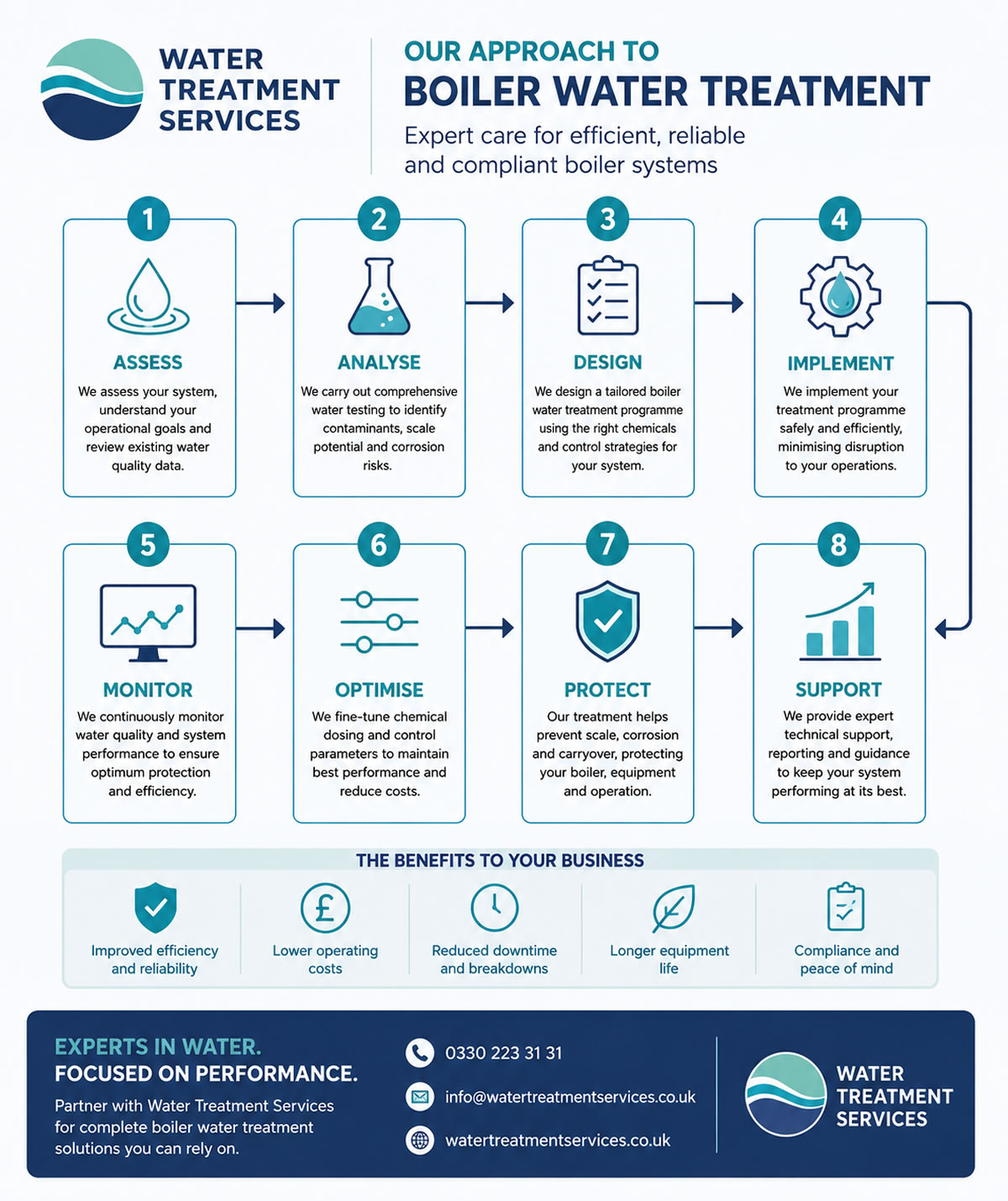
Diagram explaining Water Treatment Services holistic approach to the evaluation treatment and management of industrial steam boiler systems

Industry Sectors We Support

We work with steam systems across a wide range of industries including:

  • Cog Cog

    Manufacturing & Industrial Processing

    Where reliability and production continuity are often critical.

  • Food & Beverage

    Where steam quality and hygiene standards are particularly important.

  • Plus-squared Plus-squared

    Healthcare & Hospitals

    Where uninterrupted steam supplies support essential services.

  • Pharmaceutical Manufacturing

    Where process control and steam purity requirements can be demanding.

  • Users Users

    Universities & Education

    Operating a diverse range of ageing and modern boiler plant.

  • Home Home

    Property & Facilities Management

    Supporting commercial buildings and multi-site estates.

  • Flash Flash

    Energy & Utilities

    Where large steam systems require robust control and ongoing optimisation.

    Although the industries differ, many of the challenges remain remarkably similar.

    • Scale.
    • Corrosion.
    • Loss of condensate.
    • Poor monitoring.
    • Changes in operating conditions.

    The fundamentals of good water treatment rarely change.

Why Clients Choose Water Treatment Services

People often ask what makes one water treatment company different from another.

Our answer is usually quite simple.

We don’t believe in selling chemistry for chemistry’s sake.

After years working with steam systems, we’ve learnt that the right answer isn’t always more chemicals.

Sometimes it’s repairing a softener.

Sometimes it’s improving sampling procedures.

Sometimes it’s changing blowdown settings.

And occasionally it’s simply reassuring a client that their system is operating perfectly well and doesn’t need changing at all.

Clients choose Water Treatment Services because we provide:

  • Experienced engineers with specialist steam boiler knowledge.
  • Practical advice based on experience.
  • Bespoke treatment programmes.
  • Comprehensive monitoring and laboratory support.
  • National coverage across the UK and Ireland.
  • Responsive technical support.
  • A strong focus on efficiency, reliability and compliance.

Most importantly, we try to provide straightforward advice based on what’s best for the plant rather than what’s easiest to sell.

Frequently Asked Questions About Boiler Water Treatment

During our time in this industry we’ve found that many of the same questions come up time and again. Whether our engineers are carrying out a boiler survey, speaking with facilities managers or training boiler operators, the concerns are usually very similar.

The answers below are based on practical experience and the sort of issues we regularly encounter when investigating steam systems throughout the UK.

What is boiler water treatment?

At its simplest, boiler water treatment is about controlling the quality of the water circulating through a steam system.

The aim is to prevent scale, corrosion and contamination from damaging the boiler and associated equipment.

People sometimes think boiler water treatment is simply a matter of adding chemicals, but that’s only part of the story. In practice, good treatment is about maintaining control over the whole system.

Why is boiler water treatment important?

Because steam boilers are expensive pieces of plant and poor water quality can cause equally expensive problems.

Scale, corrosion and carryover rarely happen overnight. Most develop slowly and, if left unchecked, can increase fuel consumption, reduce reliability and shorten the life of the plant.

From what we’ve seen over the years, many failures are entirely avoidable.

How often should boiler water be tested?

That depends on the system.

Some boilers require daily testing by site personnel, while others may be supported by routine service visits and laboratory analysis.

There isn’t a single answer that suits every installation.

What matters is maintaining regular monitoring and ensuring that trends are identified before problems develop.

We’d much rather see a simple testing regime carried out consistently than an elaborate programme that nobody has time to maintain.

What causes scale inside a boiler?

Scale is normally caused by hardness salts entering the boiler.

Most commonly, the culprit is a water softener that isn’t operating correctly.

Over the years, we’ve investigated numerous scaling problems and, more often than not, the treatment chemicals weren’t at fault. The softener had stopped regenerating properly or had simply been neglected.

Even relatively small amounts of scale can affect efficiency and increase fuel costs.

Can scale really increase fuel consumption?

Yes.

This is one of the few figures that genuinely surprises people.

Just 1 mm of scale can increase fuel consumption by around 7-10%.

On larger steam systems, that can represent a considerable amount of money over the course of a year.

It’s one reason why maintaining clean heat transfer surfaces remains so important.

What causes corrosion in boiler systems?

Corrosion usually results from dissolved oxygen, carbon dioxide or unsuitable water conditions.

Poor condensate quality, inadequate oxygen scavenger levels and loss of control over water chemistry are all common causes.

We’ve seen corrosion affect everything from feed tanks and boiler tubes to condensate pipework hidden above ceilings and beneath floors.

Unfortunately, corrosion often remains unnoticed until leaks appear.

What problems do you most commonly find during boiler surveys?

Certain themes appear again and again.

Typical findings include:

  • Water softeners not regenerating correctly.
  • Failed dosing pumps.
  • Excessive blowdown.
  • Poor condensate return quality.
  • Feed tanks open to atmosphere.
  • Conductivity controllers out of calibration.
  • Lack of routine testing.
  • Changes in operating conditions that nobody has reviewed.

Interestingly, the chemistry itself is rarely the underlying problem.

Most failures occur because control has gradually been lost.

What is BG04?

BG04 is the guidance document produced by the Combustion Engineering Association covering boiler water treatment.

In our view, BG04 is far more than a compliance document.

It provides a sensible framework for managing steam systems safely and efficiently.

Following the guidance helps reduce risk, improve reliability and support good engineering practice.

What are oxygen scavengers used for?

Oxygen scavengers are used to remove residual dissolved oxygen from boiler feedwater.

Their purpose is to reduce corrosion and protect boilers, feed systems and condensate return lines.

Products such as sulphites and tannin-based treatments are commonly used, although the most appropriate treatment depends on the system and operating conditions.

Why is condensate treatment important?

Because some of the worst corrosion we’ve encountered hasn’t been inside the boiler at all.

It has been in condensate return systems.

As carbon dioxide dissolves into condensate, it forms carbonic acid which attacks pipework over time.

Condensate treatment helps protect return lines and maintain the quality of the water returning to the boiler.

It’s often overlooked, but in our experience it’s one of the most important parts of a treatment programme.

Why is blowdown necessary?

As steam is generated, dissolved solids become concentrated within the boiler.

Boiler blowdown removes these impurities and helps maintain water quality.

Without blowdown, problems such as carryover and scale can develop.

Having said that, excessive blowdown is something we see surprisingly often.

Too much blowdown wastes water, energy and treatment chemicals, so getting the balance right is important.

What is TDS?

TDS stands for Total Dissolved Solids.

These dissolved impurities naturally become concentrated inside the boiler as steam is produced.

Monitoring TDS levels helps maintain water quality and minimise the risk of carryover.

Does every boiler need water treatment?

In our opinion, yes.

Every steam boiler benefits from some form of water treatment.

The level of treatment required may vary depending on the size and operating conditions of the plant, but all boilers need suitable control over water quality.

Ignoring water treatment is rarely a good strategy.

Can boiler water treatment reduce carbon emissions?

Indirectly, yes.

Improved heat transfer and better efficiency mean less fuel is required to generate steam.

Reduced fuel consumption leads to lower carbon emissions.

In many cases, good engineering and good environmental practice go hand in hand.

Is boiler water treatment expensive?

Compared with the cost of repairing a boiler or replacing damaged pipework, no.

In fact, one of the strongest opinions we’ve formed over the years is that poor water treatment is almost always more expensive than good water treatment.

Most clients are surprised by how small the annual cost of treatment is when compared with the cost of tube failures, lost production or major repairs.

Is every boiler treatment programme the same?

Definitely not.

No two systems are identical.

Water quality, steam demand, boiler pressure, condensate return rates and operating practices all influence treatment requirements.

That’s why we’ve never been a fan of off-the-shelf chemical programmes.

Treatment should always reflect the conditions on site.

Boiler Water Treatment Training

One thing that is clear is that many steam systems suffer not because of poor chemistry, but because valuable knowledge has been lost.

Experienced operators retire.

Responsibilities change.

People inherit systems they don’t fully understand.

That’s one reason why training is so important.

Water Treatment Services has developed a range of professional water and wastewater treatment training courses, including WTS 0040 – Boiler Water Treatment and Steam Generation.

The course has been designed for:

  • Boiler operators.
  • Maintenance engineers.
  • Facilities managers.
  • Engineering contractors.
  • Water treatment professionals.
  • Anyone responsible for commercial and industrial steam plant.

The aim isn’t to turn delegates into chemists.

It’s to help people understand how steam systems behave, recognise warning signs and maintain control.

Because in our experience, informed operators remain one of the best forms of protection a boiler system can have.

Final Thoughts on Boiler Water Treatment

Having worked with commercial and industrial steam systems, one thing has become increasingly clear.

Very few boiler failures happen without warning.

Most don’t arrive suddenly.

More often, they develop quietly over a period of months or years.

A small amount of hardness leakage through a softener.

A gradual increase in blowdown.

A reduction in condensate return.

A failed dosing pump that goes unnoticed.

A conductivity controller that hasn’t been calibrated for years.

Individually, these things may not seem particularly significant. But over time, small problems have a habit of becoming expensive ones.

That’s one of the reasons we believe that good boiler water treatment is about much more than chemistry.

In fact, some of the best performing steam systems we’ve come across haven’t necessarily used the most sophisticated treatment programmes. They simply maintained good control.

The operators understood the system.

Water quality was monitored regularly.

Equipment was maintained properly.

And problems were addressed before they had an opportunity to develop.

Conversely, our engineers have investigated boilers suffering from severe scaling and corrosion despite the use of premium water treatment products.

The chemistry wasn’t the issue.

Control had been lost.

If we’ve learnt anything over the years, it’s that successful boiler water treatment relies on getting the basics right.

Good feedwater quality.

Reliable dosing equipment.

Regular testing.

Competent operators.

Effective monitoring.

And perhaps most importantly, maintaining an interest in what the system is trying to tell you.

Because boilers are remarkably good at giving warnings.

Unfortunately, those warnings are often subtle.

Rising fuel consumption.

Dirty gauge glasses.

Increasing chemical usage.

Poor condensate quality.

Frequent alarms.

Wet steam.

Corrosion around pipework.

These are rarely the problem themselves.

More often, they’re symptoms of something else that needs attention.

In our experience, the sites that achieve the greatest reliability are not necessarily the ones that spend the most money.

They’re the ones that understand their systems and maintain control over them.

That’s really what boiler water treatment is all about.

Not selling chemicals.

Not chasing test numbers.

Not generating reports for the sake of it.

Simply maintaining the conditions that allow a steam system to operate safely, efficiently and reliably.

And when you think about it, that’s exactly what good engineering has always been about.

Speak to Our Boiler Specialists

Whether you’re experiencing problems with scale, corrosion, carryover or rising fuel costs, or simply want reassurance that your current boiler treatment programme is performing as it should, we’re always happy to discuss a system and provide practical advice.

Sometimes the answer is a change in chemistry.

Sometimes it’s a softener that’s no longer regenerating properly.

Quite often, it’s simply a matter of improving monitoring and restoring control.

Whatever the issue, our approach remains the same.

  • Understand the system.
  • Identify the risks.
  • Maintain control.
  • And prevent small problems from becoming expensive ones.

With offices in London, Manchester, Birmingham, Bristol, Leeds and Glasgow, supported by experienced engineers and technical specialists, Water Treatment Services provides boiler water treatment services throughout the UK and Ireland.

If you would like to arrange a boiler water treatment survey, discuss a particular problem or simply review your existing treatment programme, we’d be pleased to help.

After all, prevention is nearly always easier, and considerably cheaper, than repair.

And if there’s one piece of advice we’d offer to you, it would be this:

Don’t wait until your boiler tells you something is wrong.

By the time it does, the underlying problem has often been developing for quite some time.

Talk to a Boiler Treatment Specialist

You may also be interested in…

Water treatment chemicals stored at Tater Treatment Services UK manufacturing facility

Industrial Water Treatment Chemicals UK

Read more
Cleaning and maintaining reverse osmosis membranes

How to Clean and Maintain Reverse Osmosis Membranes

22 December, 2025
Read more
How important are biocides in water treatment?

How Important Are Biocides in Water Treatment?

31 October, 2024
Read more
Why treat makeup water?

Why Treat Makeup Water?

12 June, 2024
Read more
How Do District Heating Systems Work?

How Do District Heating Systems Work?

6 July, 2023
Read more
What are the Advantages and Disadvantages of Heat Pumps?

What are the Advantages and Disadvantages of Heat Pumps?

18 January, 2023
Read more
How boiler water treatment affects performance

How Boiler Water Treatment Affects Performance

23 June, 2022
Read more
HVAC energy efficiency graph

Improving HVAC Energy Efficiency

14 June, 2022
Read more
Expert witness services

Expert Witness & Dispute Resolution

Read more
Ion Exchange Water Softeners

Ion Exchange Water Softeners

22 September, 2021
Read more
Previous Previous Previous Next Next Next

REVIEWS

4.8
Water Treatment Services is rated 4.8 out of 5 stars (based on 103 reviews)
Read our reviews

Submit your review here

Search Search

Water Treatment

  • Boiler Water Treatment Services
  • Cooling Water Treatment
  • Closed Loop Water Treatment
  • Cooling Tower Cleaning Services UK
  • Cooling Tower Maintenance
  • Chlorine Dioxide Water Treatment Services
  • Commercial Water Softeners
  • Expert Witness Services
  • Pre-Commission Cleaning
  • Tank Reline & Repair
  • TMV Servicing
  • Water Chlorination & Disinfection
  • Water Leak Detection
  • Water Treatment Chemicals
  • Water Testing
    • Drinking Water Testing Services UK
    • Testing Water for Heavy Metals
    • Pool Water Testing
    • BSRIA Closed System Testing
    • SDI Testing & Analysis
    • Trade Effluent Testing
  • Water Treatment Training
    • Basic Chemistry of Water
    • Industrial Treatment
    • Pre-Treatment
    • Boiler Treatment
    • Cooling Systems
    • Closed Systems
    • Wastewater Training
    • Advanced Treatment

REVIEWS

4.8
Water Treatment Services is rated 4.8 out of 5 stars (based on 103 reviews)
Read our reviews

What's New

  • Swimming Pool Water Testing UK: Complete Compliance Guide for Pool Operators & Facilities Managers

    Swimming Pool Water Testing UK: Complete Compliance Guide for Pool Operators & Facilities Managers

    Swimming pool water quality is one of those things …
  • Boiler Water Treatment Chemicals

    Boiler Water Treatment Chemicals

  • Chemicals

  • Industrial Water Treatment Chemicals UK

    Industrial Water Treatment Chemicals UK

Newsletter

Receive exciting features, news, latest research and special offers! Just add your email address and we'll do the rest.

© Copyright 2026 - EDG Ltd. Operating as Water Treatment Services
  • Link to X
  • Link to Facebook
  • Link to LinkedIn
  • Link to Mail
  • Home
  • About
  • Careers
  • Privacy
  • Environment
  • Reviews
  • Login[learndash_login login_label=”Login/Register” logout_label=”Logout”]
  • Sitemap
Scroll to top Scroll to top Scroll to top

This site uses cookies. By continuing to browse the site, you are agreeing to our use of cookies.

OK

Cookie and Privacy Settings


How we use cookies

We may request cookies to be set on your device. We use cookies to let us know when you visit our websites, how you interact with us, to enrich your user experience, and to customize your relationship with our website.

Click on the different category headings to find out more. You can also change some of your preferences. Note that blocking some types of cookies may impact your experience on our websites and the services we are able to offer.

Essential Website Cookies

These cookies are strictly necessary to provide you with services available through our website and to use some of its features.

Because these cookies are strictly necessary to deliver the website, refusing them will have impact how our site functions. You always can block or delete cookies by changing your browser settings and force blocking all cookies on this website. But this will always prompt you to accept/refuse cookies when revisiting our site.

We fully respect if you want to refuse cookies but to avoid asking you again and again kindly allow us to store a cookie for that. You are free to opt out any time or opt in for other cookies to get a better experience. If you refuse cookies we will remove all set cookies in our domain.

We provide you with a list of stored cookies on your computer in our domain so you can check what we stored. Due to security reasons we are not able to show or modify cookies from other domains. You can check these in your browser security settings.

Google Analytics Cookies

These cookies collect information that is used either in aggregate form to help us understand how our website is being used or how effective our marketing campaigns are, or to help us customize our website and application for you in order to enhance your experience.

If you do not want that we track your visit to our site you can disable tracking in your browser here:

Other external services

We also use different external services like Google Webfonts, Google Maps, and external Video providers. Since these providers may collect personal data like your IP address we allow you to block them here. Please be aware that this might heavily reduce the functionality and appearance of our site. Changes will take effect once you reload the page.

Google Webfont Settings:

Google Map Settings:

Google reCaptcha Settings:

Vimeo and Youtube video embeds:

Other cookies

The following cookies are also needed - You can choose if you want to allow them:

Privacy Policy

You can read about our cookies and privacy settings in detail on our Privacy Policy Page.

Privacy
Accept settingsHide notification only