
Boiler Water Treatment Chemicals
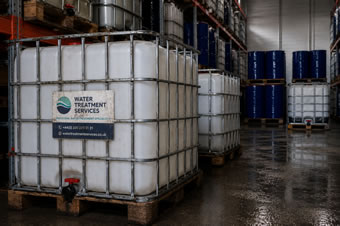
Water Treatment Services offer a full range of high-performance boiler water treatment chemicals.
Water Treatment Services supply a comprehensive range of high-performance boiler water treatment chemicals for commercial and industrial steam generating systems throughout the UK and overseas. Our experience includes support for everything from small packaged shell boilers serving commercial buildings to large scale high-pressure steam installations operating in a range of industrial, commercial and process environments.
One thing experience teaches you very quickly is that there is no such thing as a standard boiler. Two systems operating at the same pressure can require completely different water treatment programmes because the feedwater quality, condensate return rates, steam demand and operating practices are rarely identical. For that reason, selecting boiler chemicals should never simply be a case of choosing a product from a catalogue.
At Water Treatment Services we firmly believe that good treatment starts by understanding how the whole steam system behaves.
Selecting the Right Boiler Water Treatment Chemicals
When assessing a boiler system, you need to look beyond the boiler itself.
Factors that influence chemical selection include:
In practice, these factors determine whether a simple water treatment programme will provide adequate protection or whether individual chemical products are required to achieve greater control.
A small low-pressure shell boiler in a hotel may operate perfectly with a single multi-functional treatment product, whereas a larger, industrial steam system serving a manufacturing process may benefit from separate oxygen scavenger, phosphate and condensate treatment chemicals.
Experience has shown us that trying to simplify chemistry too far often creates more problems than it solves.
All of our products are backed by practical technical advice, water analysis and ongoing support to ensure they continue to perform as intended.
Why Boiler Chemical Programmes Need to Be Balanced
One observation that comes from years of investigating steam systems is that problems are often caused by imbalance rather than an absence of chemicals.
We regularly encounter systems where operators have increased dosage rates in an attempt to solve a problem, only to create another.
Too little treatment allows corrosion and deposits to develop. Too much treatment can contribute to high dissolved solids, foaming, carryover and excessive blowdown losses.
Successful boiler water treatment is about maintaining stable conditions rather than chasing ever higher chemical residuals.
Consistency nearly always produces better results than over-treatment.
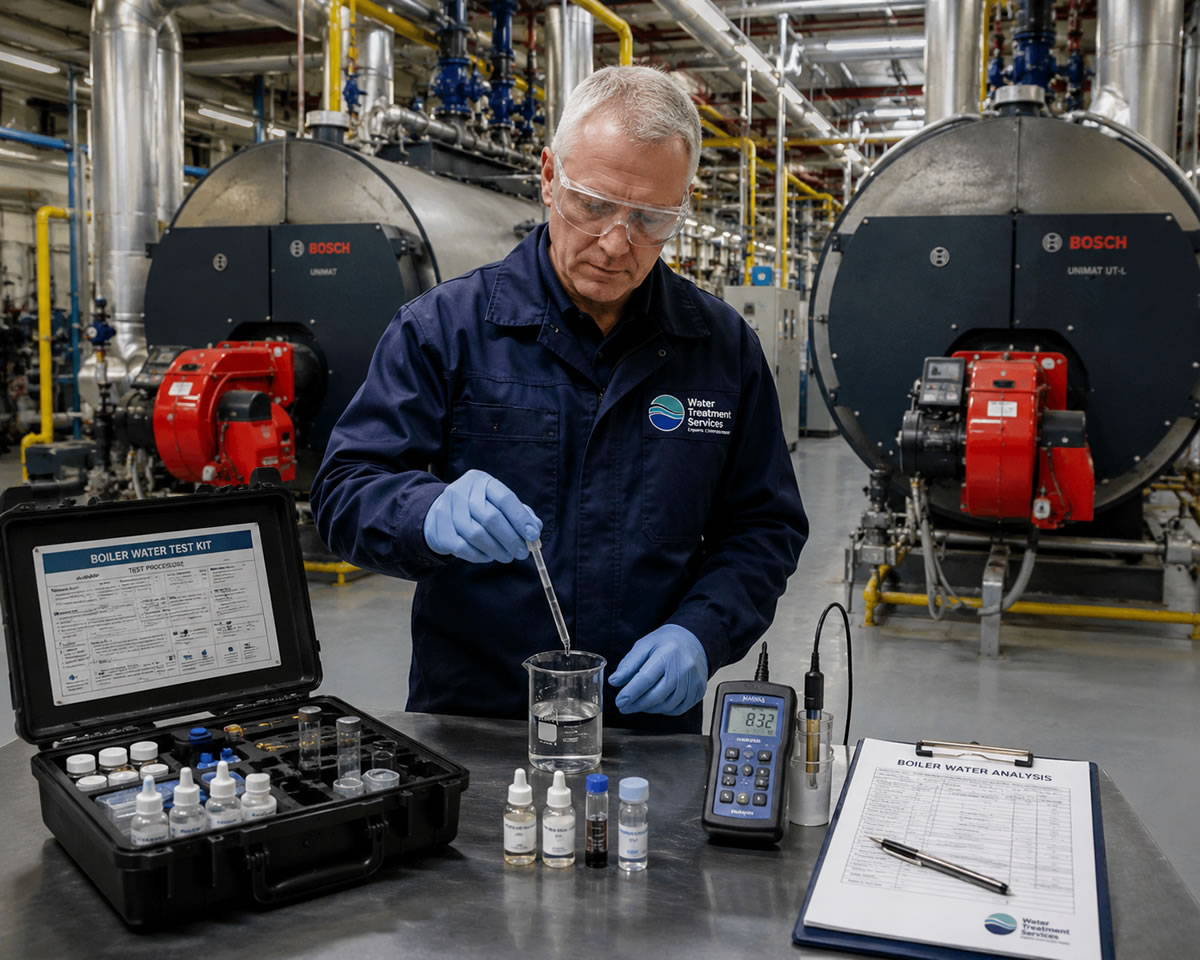
Multi-Functional (Single Drum) Boiler Treatment Chemicals
Many commercial and industrial boilers operate successfully using multi-functional (single drum) treatment products.
These blended formulations typically combine several functions within one product, including:
- Oxygen scavengers.
- Alkalinity builders.
- Phosphate reserve.
- Polymer sludge conditioners.
Their main advantage is simplicity. Operators only need to manage one chemical and one dosing system, which reduces complexity and makes routine control easier.
Over the years, we have found these products particularly suitable for:
- Hotels.
- Hospitals.
- Schools and universities.
- Laundries.
- Commercial buildings.
- Smaller manufacturing facilities.
Providing feedwater quality is satisfactory, single drum, multi-functional treatments offer reliable and economical protection.
Choosing Between Multi-Functional and Separate Boiler Chemicals
There is no universal answer to the question of whether multi-functional or separate chemical treatment products are best, and we offer both options for ultimate flexibility.
Multi-functional products have the following advantages:
- Simple operation.
- Fewer dosing points.
- Easier stock control.
- Reduced operator involvement.
Separate chemical products offer:
- Greater flexibility.
- More precise control.
- Independent adjustment of treatment parameters.
- Better suitability for larger or higher-pressure systems.
In our experience, smaller boilers often perform well with single drum multi-functionals.
Larger steam plants and systems with demanding steam quality requirements frequently benefit from separate chemical control. Individual products allow oxygen scavenging, phosphate reserve and condensate treatment to be adjusted independently as operating conditions change.
Ultimately, the chemical programme should suit the boiler system, not the other way around.
Boiler Water Treatment Chemicals
We supply and support a wide range of high-performance, advanced-technology chemicals for the treatment of boilers and steam generating systems, including:
Boiler Oxygen Scavenger Chemicals
Residual dissolved oxygen remains one of the primary causes of corrosion within steam generating systems.
Even efficient thermal deaerators do not remove oxygen completely, which is why chemical oxygen scavengers form such an important part of many water treatment programmes.
We supply a range of high-performance oxygen scavenger products including:
- Sodium sulphite formulations.
- Catalysed sulphite treatments.
- Carbohydrazide products.
- DEHA-based oxygen scavengers.
- Specialist volatile products for higher-pressure applications.
Over the years, we have seen severe pitting corrosion develop where oxygen control has been neglected. In some cases, feed tanks and economisers have suffered far more damage than the boiler itself.
Selecting the correct boiler oxygen scavenger depends on operating pressure, steam quality requirements and the overall design of the system.
The selection and control of oxygen scavengers forms an important part of our specialist boiler water treatment services.
Phosphate Boiler Treatment Chemicals
Phosphate treatment remains one of the most established methods of controlling residual hardness within steam boilers.
Despite advances in polymer technology, phosphate chemistry continues to provide reliable protection and remains widely used throughout industry.
Phosphate treatments react with traces of hardness and convert them into a fluid sludge that can be removed by blowdown.
We supply a range of high-performance phosphate products including:
- Trisodium phosphate products.
- Blended phosphate treatments.
- Polymer phosphate formulations.
- Coordinated phosphate programmes.
- Specialist products for higher-pressure boilers.
From experience, maintaining stable phosphate levels is far more important than attempting to maintain excessively high reserves.
Good control generally delivers better results than excessive chemical dosage.
Polymer Dispersants and Sludge Conditioners
Many boiler problems that appear to be scaling are actually caused by poor sludge management.
Modern polymer dispersants help keep suspended solids mobile and prevent deposits from adhering to heat transfer surfaces.
Without adequate dispersion, contaminants can accumulate beneath deposits and create localised corrosion cells.
We supply a range of high-performance polymer dispersants and sludge conditioners.
Effective sludge conditioning improves circulation and supports efficient blowdown.
Over the years, we have found that relatively small improvements in sludge control can often produce significant improvements in boiler cleanliness.
Condensate Line Treatment Chemicals
Steam systems do not end at the boiler.
Condensate return pipework is often where some of the most serious corrosion occurs.
Carbon dioxide released from boiler water dissolves in condensate to form carbonic acid and left untreated, this acidic condensate gradually attacks steel and copper pipework.
Because boiler condensate systems are often hidden from view, deterioration frequently goes unnoticed until failures begin to occur.
We supply a range of high-performance condensate line products including:
- Neutralising amines.
- Blended condensate treatments.
- Volatile corrosion inhibitors.
- Products for systems with high condensate return rates.
Protecting a boilers condensate system not only reduces corrosion but also helps minimise iron contamination returning to the feed tank.
pH and Alkalinity Control Chemicals
Maintaining the correct pH and alkalinity is essential for controlling corrosion and creating stable operating conditions within a steam boiler.
While low alkalinity can allow acidic conditions to develop, excessive alkalinity can contribute to foaming, carryover and unnecessarily high dissolved solids. In our experience, maintaining consistent control is far more important than simply aiming for the highest possible pH.
We supply a range of pH and alkalinity control chemicals for boiler systems, including:
- Caustic soda formulations.
- Sodium carbonate products.
- Sodium bicarbonate treatments.
- Blended alkalinity builders.
- Multi-functional boiler treatment chemicals.
The most suitable product depends on boiler pressure, feedwater quality and the overall treatment programme.
Over the years, we have found that changing pH values are often a symptom of wider issues within the steam system. Increased make-up water, condensate losses and poor blowdown control can all influence alkalinity levels and should be investigated before simply increasing chemical dosage.
Higher-pressure boilers generally require tighter control, but stable chemistry is important in every steam system. Maintaining pH and alkalinity within the recommended limits helps support other treatment chemicals and contributes to reliable long-term operation.
Boiler Water Antifoam Chemicals
Boiler water antifoams are used to control foaming and help maintain good steam quality. Excessive foaming can lead to priming and carryover, allowing water droplets and dissolved solids to be carried over with the steam and potentially causing problems elsewhere in the system.
Foaming can occur for several reasons, including high dissolved solids, excessive alkalinity, process contamination or chemical overfeed.
In our experience, antifoams are most effective when used to support a well-controlled treatment programme rather than as a substitute for correcting underlying water quality issues.
We supply a range of boiler water antifoam chemicals suitable for commercial and industrial steam systems, including:
- Silicone-based antifoams.
- Non-silicone formulations.
- Multi-functional boiler treatment products incorporating antifoam properties.
- Specialist products for applications where steam purity is critical.
Over the years, we have found that persistent foaming problems often indicate changes elsewhere within the system. Poor blowdown control, condensate contamination or excessive chemical dosage are frequently the root cause and should be investigated alongside the use of antifoam products.
Maintaining stable boiler conditions and controlling dissolved solids remain the most effective means of preventing carryover and ensuring reliable steam production.
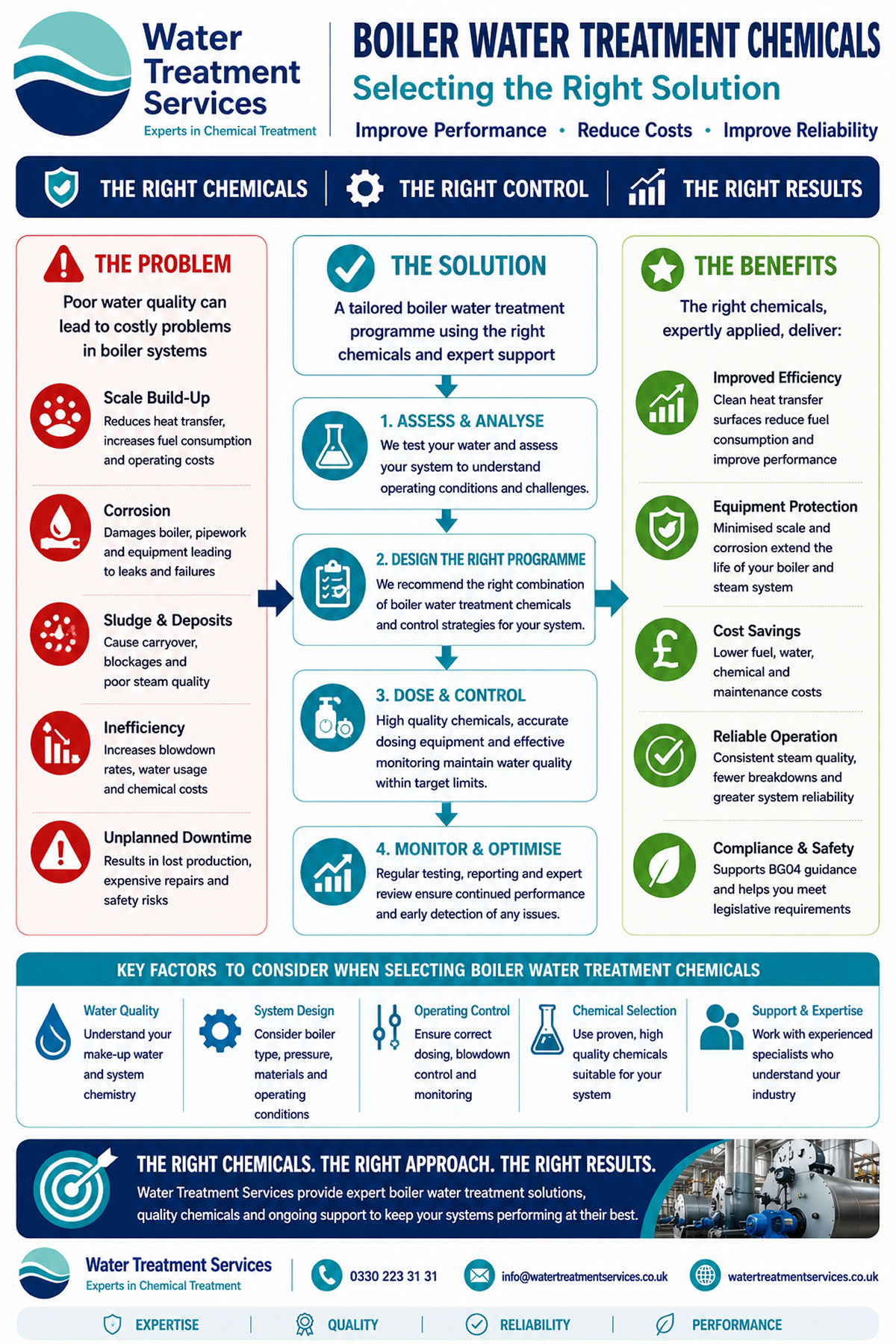
Boiler Chemical Dosing Systems
Even the best chemistry cannot provide protection if it is not being introduced in to the system correctly.
You may be surprised to learn that many treatment failures are ultimately mechanical rather than chemical.
Common problems we encounter include:
- Empty chemical containers.
- Failed dosing pumps.
- Blocked injection quills.
- Incorrect timer settings.
- Poor injection locations.
- Lack of routine monitoring.
For this reason, Water Treatment Services also supplies and supports high-quality, reliable:
- Chemical dosing pumps.
- Day tanks and bunds.
- Injection assemblies.
- Water meters.
- Conductivity controllers.
- Automated blowdown systems.
Reliable dosing arrangements are every bit as important as the chemistry itself.
Supporting Feedwater Treatment Plant
Chemical treatment works most effectively when supported by appropriate feedwater treatment equipment.
Depending upon the application, this may include:
- Water softeners.
- Reverse osmosis systems.
- Dealkalisation plant.
- Thermal deaerators.
- Condensate polishing equipment.
- Side-stream filtration systems.
One lesson experience has taught us is that attempting to compensate for poor feedwater quality by simply increasing chemical dosage rarely produces the best long-term results.
Good plant design and good chemistry should always complement one another.
In our experience, correctly maintained commercial water softeners remain one of the most important components of any successful boiler treatment programme.
Common Boiler Water Treatment Problems We Encounter
Although every steam boiler system is different, certain issues appear time and again.
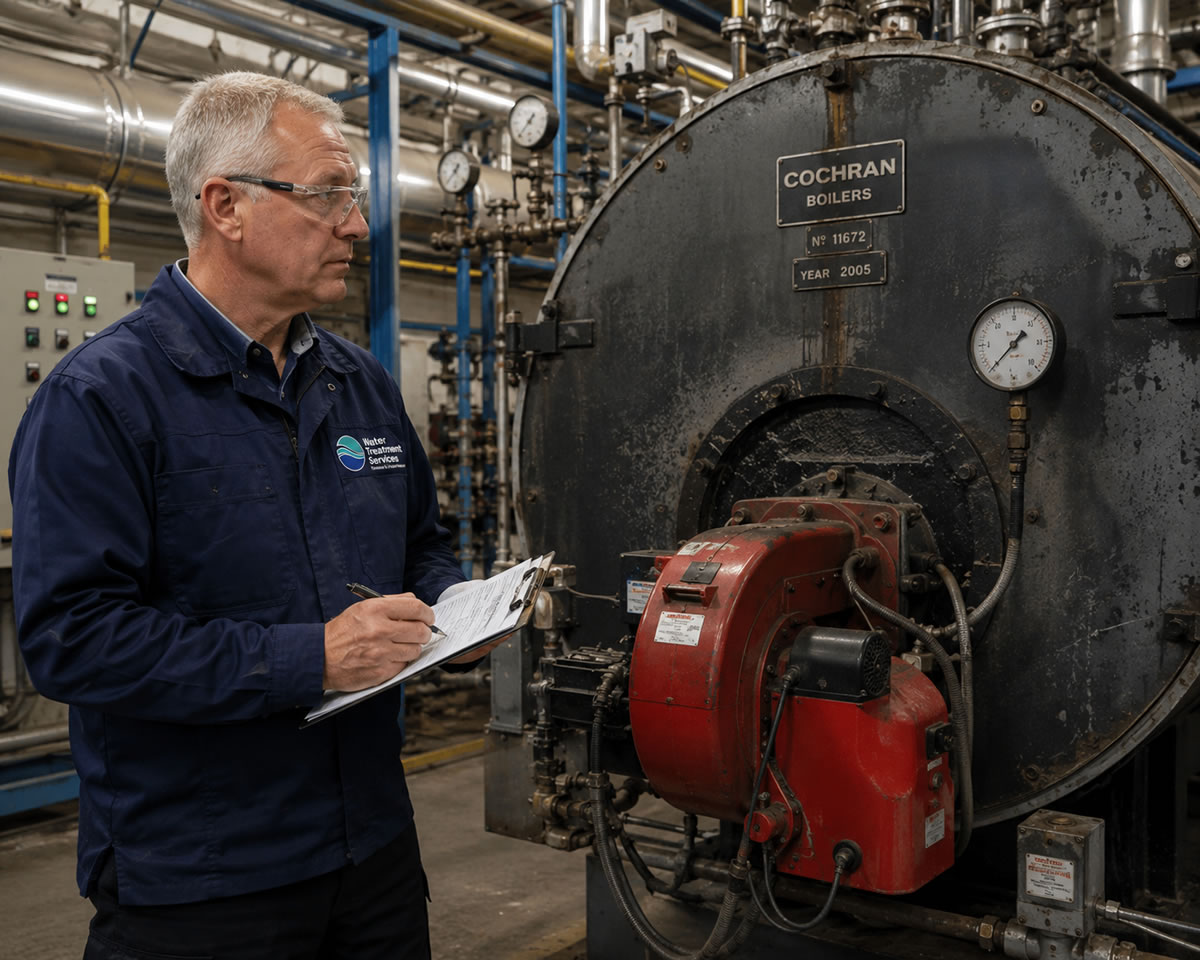
Frequently Asked Questions About Boiler Water Treatment Chemicals
What chemicals are used in steam boilers?
Most steam boiler treatment programmes contain a combination of chemicals rather than a single product. Depending on the application, these may include oxygen scavengers, phosphate treatments, alkalinity builders, polymer dispersants, antifoams and condensate line treatments.
The exact combination depends on the boiler pressure, feedwater quality and the overall design of the steam system. In practice, no two boiler systems are exactly alike, so treatment programmes should always be selected to suit the individual application.
Can softened water replace boiler chemicals?
No.
Water softeners remove hardness minerals such as calcium and magnesium, but they do not remove dissolved oxygen, carbon dioxide, alkalinity or dissolved solids.
Softening forms part of the water treatment process, but it does not replace chemical treatment.
From experience, this remains one of the most common misunderstandings surrounding steam boiler operation.
What is the purpose of an oxygen scavenger?
Oxygen scavengers remove residual dissolved oxygen from boiler feedwater.
Even with efficient thermal deaeration, some oxygen remains. If left untreated, it can cause localised pitting corrosion, particularly within feed tanks, economisers and boiler tubes.
In our experience, oxygen-related corrosion is often far more destructive than general corrosion because it produces deep pits that can penetrate steel surprisingly quickly.
What does phosphate do in a steam boiler?
Phosphate reacts with traces of hardness entering the boiler and converts them into a fluid sludge which can be removed by blowdown.
This prevents hard, adherent scale from forming on heat transfer surfaces.
Phosphate treatment has been used successfully for decades and remains an important part of many boiler treatment programmes.
Are phosphate treatments still used in modern boilers?
Yes.
Despite developments in polymer technology, phosphate treatment remains widely used throughout industry.
Over the years, many treatment philosophies have come and gone, but phosphate chemistry continues to provide reliable protection when properly controlled.
Modern formulations often combine phosphate with polymer dispersants to improve sludge conditioning and overall cleanliness.
What is a single drum or multi-functional boiler treatment?
Single drum treatments are blended products containing several treatment components within one formulation.
These products typically include:
- Oxygen scavengers.
- Phosphate reserve.
- Alkalinity builders.
- Polymer dispersants.
They are particularly suited to small and medium-sized shell boilers because they simplify chemical dosing and routine control.
Providing feedwater quality is satisfactory, multi-functional products offer excellent protection.
Are separate boiler chemicals better than blended treatments?
Not necessarily.
Blended treatments work extremely well on many systems. Separate products simply provide greater flexibility and allow individual treatment parameters to be adjusted independently.
Generally speaking, larger or higher-pressure systems benefit from separate chemical control, while smaller packaged boilers often operate very successfully with blended products.
The right answer depends on the system rather than the chemicals themselves.
How often should boiler water be tested?
Testing frequency depends on the size and criticality of the system.
Some boilers require daily checks, while others may only need testing several times each week.
As a minimum, routine monitoring should include:
- Boiler water conductivity.
- pH.
- Phosphate reserve.
- Sulphite residual.
- Feedwater hardness.
- Condensate pH.
In our experience, lack of testing is responsible for many of the problems encountered in steam systems.
Can too much boiler chemical cause problems?
Yes.
More chemical does not automatically provide better protection.
Excessive dosage can contribute to:
- Foaming.
- Carryover.
- High dissolved solids.
- Increased blowdown losses.
- Poor steam quality.
One of the most common mistakes we encounter is operators attempting to solve water quality problems simply by increasing dosage rates.
Maintaining stable control almost always delivers better results.
Why is my boiler foaming?
Foaming can occur for several reasons, including:
- High dissolved solids.
- Excessive alkalinity.
- Process contamination.
- Overdosing chemicals.
- Inadequate blowdown.
Foaming itself is not always the problem. More often, it is a symptom of underlying water chemistry issues.
Identifying the cause is usually more effective than simply adding antifoam chemicals.
Why are condensate lines corroding?
Condensate corrosion is usually caused by carbon dioxide.
As steam condenses, carbon dioxide dissolves in the water to form carbonic acid, lowering pH and attacking steel pipework.
Because condensate systems are largely hidden, deterioration can continue unnoticed for years.
We have inspected systems where the boiler remained in excellent condition, yet condensate lines had suffered severe internal thinning.
Condensate treatment chemicals help minimise this type of attack.
Why are feed tanks corroding?
Feed tanks are particularly vulnerable because they contain warm, oxygen-rich water.
Common causes include:
- Poor oxygen scavenger control.
- Inadequate deaeration.
- Excessive make-up water.
- Low feed tank temperatures.
- Poor condensate return quality.
In many systems, feed tanks suffer more corrosion than the boiler itself.
Why is my boiler using more chemicals than before?
Increased boiler chemical consumption often indicates an underlying change within the system.
Possible causes include:
- Loss of condensate return.
- Softener leakage.
- Increased blowdown.
- Changes in mains water quality.
- Higher steam demand.
- Dosing equipment faults.
In our experience, a sudden increase in chemical usage is usually a symptom rather than the problem itself.
Why is my boiler consuming more fuel?
Reduced efficiency may result from:
- Scale formation.
- Poor blowdown control.
- Excessive make-up water.
- Steam leaks.
- Poor combustion.
- Condensate losses.
Even relatively thin deposits can have a noticeable impact on fuel consumption.
Maintaining clean heat transfer surfaces remains one of the most effective ways of controlling energy costs.
Can water treatment chemicals damage my boiler?
When correctly selected and controlled, no.
However, poor chemical control can create problems.
Excessive alkalinity, overdosing and incorrect product selection can all contribute to operational difficulties.
This is why water treatment programmes should be based on water analysis and operating conditions rather than simply adding more chemicals.
Why are my boiler tubes scaling when the water softener is working?
Softener problems are not always obvious.
Common causes include:
- Occasional hardness leakage.
- Exhausted resin.
- Faulty regeneration.
- Incorrect settings.
- Bypass valves left open.
Even small amounts of hardness entering the boiler over time can lead to deposit formation.
Maintaining both the softener and the chemical programme is essential.
How long do boiler chemicals last?
Most liquid boiler treatment chemicals have a long storage life when kept in suitable conditions.
Products should be protected from:
- Frost.
- Excessive heat.
- Direct sunlight.
- Contamination.
Specific storage recommendations vary between products, and chemical stock should always be rotated to ensure older material is used first.
What industries use boiler water treatment chemicals?
Steam boiler chemicals are used throughout:
- Food and beverage production.
- Pharmaceutical manufacturing.
- Healthcare facilities.
- Hotels and leisure centres.
- Universities and schools.
- Laundries.
- Manufacturing and process plants.
- Breweries and distilleries.
- Chemical processing industries.
Although the chemistry may differ, the objectives remain the same — maintaining efficiency, preventing scale and corrosion and ensuring reliable steam production.
How do I know which boiler water treatment chemicals are required?
Selecting the correct chemicals depends on several factors, including:
- Boiler pressure.
- Feedwater quality.
- Type of pretreatment plant.
- Condensate return percentage.
- Steam purity requirements.
- Operating conditions.
In practice, selecting the right treatment programme involves understanding the whole steam system rather than focusing solely on the boiler.
That is why Water Treatment Services supports its products with water analysis, technical advice and practical experience developed from years working with commercial and industrial steam systems.
Technical Support and Boiler Chemical Supply
Water Treatment Services do considerably more than simply supply water treatment chemicals.
With extensive experience working with commercial and industrial steam systems, we understand that every installation has its own operating characteristics.
Changes in water supply, condensate return rates, plant upgrades and production demands all influence boiler chemistry. A treatment programme that performed perfectly ten years ago may no longer be the most appropriate solution today.
For this reason, we support our clients and products with:
- Water analysis.
- Product selection advice.
- Dosing recommendations.
- Monitoring guidance.
- Site surveys.
- Troubleshooting support.
- Boiler system inspections.
- Water treatment training.
Our aim is not simply to sell chemicals, but to ensure the whole steam system operates efficiently, reliably and safely.
Whether you operate a small packaged boiler or a large complex steam raising plant, Water Treatment Services can provide the products and technical support needed to protect valuable equipment and maintain dependable steam production.
If you are reviewing an existing treatment programme, installing new plant or experiencing problems with corrosion, deposits or inconsistent water quality, contact Water Treatment Services to discuss the most appropriate boiler water treatment chemicals for your system.
You may also be interested in…




REVIEWS
Submit your review here