
Preventing Steam Condensate Corrosion in Industrial Boiler Systems
Preventing steam condensate corrosion in industrial boilers and steam generating systems is important for several reasons. When implemented correctly, corrosion prevention measures can help to ensure boiler plant and any associated equipment is protected, systems do not deteriorate prematurely, performance is optimised, repairs and down-time are kept to a minimum, and steam quality is maintained.
The boiler specialists at Water Treatment Services review the common causes of condensate corrosion and a number of popular water treatment techniques that can be introduced to control the problems effectively.
What causes corrosion in steam condensate systems?
Steam condensate is something that is produced by all steam boilers.
During the operation of a steam boiler water is heated to high temperatures to create steam which is then used for various purpose, this steam eventually cools and returns to its liquid (water) state.
The condensate itself is considered high-quality water, and as such many boiler systems are designed to recycle it back into the steam boiler for reuse.
Reusing the condensate has a number of benefits, it helps the environment, and saves costs by reducing the need for feed water, chemicals and energy.
Any system for re-using steam condensate in this way represents a large capital investment for a business.
What are the different types of corrosion in steam condensate systems?
If corrosion and other problems within the steam system are allowed to occur unchecked, then this can impact significantly on the way both the steam generator and business operate.
The main causes of steam condensate corrosion in these types of systems are typically oxygen pitting and carbonic acid.
Both can result in unexpected plant shutdowns which can halt production.
A steam boiler system suffering from corrosion is also less efficient, and if the problems are left unchecked, they can increase the risk of leaks.
Additionally, if corrosion by-products enter the feed-water serving the boiler, this can cause irreparable damage.
Carbonic acid
Carbonic Acid forms when carbon dioxide in the steam condenses back into water.
The carbon dioxide in the water occurs naturally when the carbon particles naturally present in the water breakdown when exposed to heat.
It doesn’t take much dissolved carbon dioxide to increase the overall pH of the steam condensate to levels which cause corrosion.
The risk of problems caused by corrosion due to carbonic acid greatly increases with higher levels of alkalinity and higher levels of carbon dioxide in the steam.
The easiest way to spot corrosion problems caused by carbonic acid is to look for “grooving” in the condensate system pipework.
The most obvious sign is thinning of pipework, especially at the threaded fitting.
Look also for signs of similar deterioration close to steam traps.
Oxygen pitting
Oxygen pitting is typically caused by dissolved oxygen in the steam condensate.
It often happens when oxygen isn’t being removed from the feedwater properly.
Oxygen can also be present because of the action of steam condensing and then cooling… as this creates a vacuum which can pull air into the system.
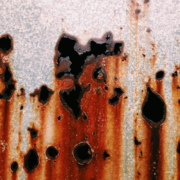
The tell-tale signs of oxygen pitting are small areas of intense pitting within the condensate system.
Pitting can cause the metal components of the system to fail completely.
The problem can be made even worse in the pH of the condensate water is low.
Protecting your steam generating system from condensate corrosion
There are a number of water treatment techniques used to protect steam generating systems from the effects of corrosion including:
Neutralising amines
Using neutralising amines is one of the most common ways of protecting against damage from carbonic acid in the steam condensate system.
Neutralising amines are water treatment chemicals such as cyclohexylamine and diethylaminoethanol (DEAE) which react with steam in a similar way to carbon dioxide.
The amines neutralise the acid, and raise the pH to nearer neutral.
This works well with carbonic acid related corrosion but does nothing to address problems of oxygen pitting.
Filming amines
Using filming amines is a technique that introduces a chemical barrier that protects the steam system against both oxygen pitting and carbonic acid corrosion.
The idea behind this technique is to keep the pH somewhere between 6.0 and 7.5.
You might need to use a neutralising amine too.
The thin layer, or film, formed by these amines is delicate, so it is important to monitor the system carefully to control corrosion rates.
Applying filming amines can also be tricky, especially for the first time.
The best course of action is to start the process slowly, making sure everyone is aware of the limits of the programme.
Volatile oxygen scavengers
Volatile oxygen scavengers are speciality water treatment chemicals such as DEHA (diethylhydroxyamine) and are often used to protect against oxygen pitting.
The advantage to using oxygen scavengers is that there are fewer limitations than using filming amines.
It can also deliver better results as it acts on both oxygen and metals.
Many operators use DEHA in conjunction with a neutralising amine to tackle carbonic acid.
Pre-treatment of boiler water
Given that carbonic acid is one of the main causes of steam condensate corrosion, then an obvious solution is to remove the carbon dioxide from the water before it enters into the steam boiler system in the first place.
Dealkalisers used in conjunction with boiler water softeners can help to reduce the pH level of water entering the boiler.
Reverse osmosis (RO) systems can both reduce alkalinity and remove other dissolved particles from the boiler feed-water.
This allows the boiler to work more efficiently, saving you money on energy bills and volumes of water and any effluent.
Corrosion monitoring for steam generating systems
To determine that your chosen method of corrosion control is working, you will need to implement a system for monitoring and water testing for at least the following parameters:
- Soluble and insoluble levels of iron,
- pH levels – pH levels should be tested at various points in your system.
- Metallic corrosion using condensate corrosion coupons.
Is your boiler operating at peak performance?
Find out with our online boiler health check …
How confident are you that your boiler system is operating at peak performance? Even small water quality issues can lead to scale formation, corrosion, reduced efficiency, increased fuel consumption and costly breakdowns.
Answer 15 quick questions (time to complete is only 3-5 minutes) to discover how healthy your boiler system is and identify opportunities to improve efficiency, reliability and lifespan.
Boiler treatment training
Our industrial and process water treatment specialists have developed an extensive series of professional water and wastewater treatment training courses including WTS 0040 “Boiler Water Treatment & Steam Generation”.
This specialist boiler treatment training course is an intensive one day course designed for boiler plant operators, plant managers, maintenance and engineering contractors, water treatment specialists and those with responsibility for the operation and on-going maintenance of commercial and industrial boilers and steam generating plant.
Industrial steam boiler and corrosion control specialists
Water Treatment Services offer a comprehensive range of water treatment solutions for the management and treatment of corrosion in industrial boilers and steam generating systems.
Our experts can help you optimise costs and operational efficiencies, reduce downtime, achieve water and energy savings, and increase plant reliability and safety.
With offices in London serving the South and South East England, Manchester (North West), Birmingham (Midlands), Bristol (South East England and Wales), Leeds (North and North East) and Glasgow (Scotland), supported by regional teams of specially trained technicians and consultants we can offer professional, cost effective corrosion prevention and protection, water treatment and engineering services throughout the UK and Internationally.
Contact us today to learn how our steam boiler management solutions can help you.
Further reading…
More information about our industrial boiler water treatment and corrosion control solutions … here →