
Treating Wastewater and Effluent: Finding the Best Approach for Your Business
In this article the industrial water specialists at WTS look at how to select the best ways to treat your industrial and commercial wastewater and trade effluents.
The article looks at why you need to treat your waste, the role of the water utility companies, the impact of discharge consents and what they mean in practice. It goes on to explore different treatment strategies covering wastewater testing and the use of common speciality treatment chemicals and odour control agents.
Why do you need a consent to discharge your wastewater?
Many businesses need to apply for a formal consent to discharge to be able to send their wastewater to the public sewer system. It’s not as simple as receiving a nod either – the water utility company will most likely impose various conditions that must be met for the business to adhere to the consent in order to discharge its wastewater or trade effluent. If this does not happen, the business may find itself on the receiving end of a fine, or even prosecution. In the worst cases the water company may even revoke your consent to discharge which could have serious consequences and even impact the viability of your business.
Hence why many businesses adopt various methods to treat their wastewater and effluent before it is discharged. This pre-discharge treatment process ensures the wastewater meets all the conditions imposed by the water company, thereby reducing any risk of a fine, or worse.

What should wastewater be tested for?
The specifics of wastewater testing will depend on the industry or business involved. For instance, a food-based business likely won’t need to worry about heavy metals entering the water, but oils and fats will be a concern. Similarly, the car industry will need to consider heavy metals. Thus, focusing on the specifics of the business and its waste products is vital to be able to ensure the correct treatments are applied.
If you fail to meet the conditions of your discharge consent you may find yourself on the receiving end of a fine, prosecution… or worse
What are the main chemical methods used in wastewater treatment?
pH neutralisers
The first chemical treatment method to look at is pH neutralisers. These are used to make sure the wastewater is as close to neutral (pH 7) as possible. Anything too acidic or too alkaline in nature can cause issues further down the line.
Antifoaming agents
Next up is a group of speciality chemicals known as anti-foaming agents or simply antifoams. This term is self-explanatory – while there are several chemicals that fall into this bracket, they all work to prevent or limit the formation of foam from the wastewater. Foam can become caught in various parts of the system, including inside pipework. Since bacteria loves feeding on things like this, excess foam in wastewater can lead to an increased chance of bacterial growth in many parts of the system.
Flocculants and coagulants
Next, there are flocculants and coagulants. Coagulants neutralise many suspended particles in the wastewater. Suspended particles often do not clump together, instead remaining separate and floating in the wastewater. The addition of coagulants make it easier for the free floating particles to coagulate, making the removal process easier. That’s where flocculants come in – they are added to make the clumping process even easier to achieve. While flocculants are a different type of polymer chemical to coagulants, they both work in harmony to make removal of these unwanted particles from the wastewater much easier.

What about odour control?
So far, we’ve focused on removing various things from wastewater to make it easier to meet the quality standards set within the consent to discharge requirements. One thing we haven’t mentioned is odour. Depending on what is in the wastewater, there is a distinct possibility that it may emit an odour of some kind. Even if that odour is innocent enough, it should ideally be removed or controlled. There are various odour control additives that can be used to achieve this purpose.
Testing your wastewater is the starting point when developing your treatment strategy
How to treat the wastewater produced by your business?
Clearly, treating wastewater and trade effluent is essential. The water company accepting your wastewater will treat it further as part of its remit, but you cannot simply send wastewater as it is produced into the sewer system. You are likely to need to treat it onsite first, to remove as much as possible from it before discharging it into the sewer. This is even more important if you discharge into a natural lake or river, but it is no less vital for those discharging into a public sewer system.
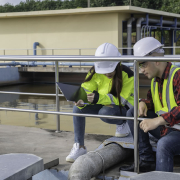
So, where to begin? The answer is by engaging the services of a professional to test your wastewater first. This will determine what it contains, and therefore indicate which methods are best used to remove as much as possible from the wastewater to allow you to comply with your discharge consent.
It’s not just a case of looking at which methods to use and adopting those, either. The use of chemicals to improve the quality of the wastewater will require correct dosing at pre-determined intervals. This is imperative because dosing too heavily may lead to the excess chemicals remaining in the wastewater. It would also incur heavier costs. Indeed, if this were to occur, the business could incur charges from the water company for the wastewater containing too much of a certain chemical. Relying on the services of an expert to determine the correct methods to use and when to use them can save you a lot of money.
Getting your wastewater treatment right can save your business money
Initial testing to determine the best way to manage your wastewater or trade effluent – and the best methods for treating it prior to discharge – is clearly essential. However, this is only the first step in a much longer process. Regular testing is imperative to help you determine that the adopted treatment methods are working as they should. Indeed, some authorities stipulate that this must occur, so that you have proof that you are doing everything you can to make sure your wastewater is safe.

We know that failing to comply with the terms of a consent to discharge will lead to fines. In more serious cases, it can lead to prosecution. However, it’s not just about fines. The regulatory body that issues your consent to discharge can revoke it, too. This would make it illegal to continue running your business, since it would mean you can no longer discharge any wastewater into the sewers as previously agreed.
The loss of income from a shutdown could be significant. Hence, the importance of adopting the correct methods to help your business produce the cleanest and safest wastewater possible.
While there is a cost involved in treating your wastewater, it is a necessary one. However, by requesting the services of a professional to manage, test and identify the elements to be removed from your wastewater, you can make sure you are able to adopt the best and most practical methods you can.
There are many green wastewater treatment methods around today as well, with mechanical and biological options available in contrast to the chemical methods commonly used in the past. These have the bonus of being more appealing to your consumers and prospects, as they seek to use businesses that are greener than the competition. Where wastewater is concerned, finding the greenest methods to use brings yet another advantage.
Industrial wastewater and trade effluent solutions
Water Treatment Services offer a comprehensive range of innovative wastewater and trade effluent solutions for business. Our specialists provide expert advice and support to help you identify the most appropriate strategies for the identification and implementation of cost efficient and environmentally sensitive wastewater treatment solutions for all industrial wastewaters and trade effluents.
With offices in London serving the South and South East England, Manchester (North West), Birmingham (Midlands), Bristol (South East England and Wales), Leeds (North and North East) and Glasgow (Scotland), supported by regional teams of specially trained environmental engineers and wastewater treatment specialists we offer cost effective environmental support solutions across the whole of the UK and internationally.
Contact us today to learn how our wastewater management solutions can help you optimise your treatment costs and improve environmental performance.